MS Dhoni’s journey from Ranchi’s dusty streets to becoming one of cricket’s most iconic captains reads like a Bollywood script.
A small-town boy who worked as a railway ticket collector, Dhoni burst onto the international scene with fearless batting that disregarded conventional wisdom about how wicketkeeper-batsmen should play.
His long hair flowing, his bat swinging with brutal power, and his stumping speed defying belief, Dhoni arrived in 2004 and immediately began rewriting cricket’s rulebook about what was possible from lower-middle order positions.
His rise coincided with India’s transformation from talented underachievers to champions across formats.
Dhoni’s fearless batting approach—launching sixes over long-on with minimal footwork, inventing the now-famous “helicopter shot,” and finishing matches with calculated aggression – made him box office.
But beyond personal flair, Dhoni possessed an exceptional cricket brain that made him India’s most successful captain.
Leading India to the 2007 T20 World Cup in his captaincy debut, the 2011 ODI World Cup at home (finishing the final himself with 91*), and the 2013 Champions Trophy, while also taking India to number one in Test rankings, Dhoni’s captaincy record remains unmatched.
Throughout his 15-year international career spanning 90 Tests, 350 ODIs, and 98 T20Is, Dhoni accumulated 17,092 runs at an average of 46.38 with a strike rate of 90.33.
However, when examining MS Dhoni Total Centuries—just 16 hundreds across all formats—the number appears surprisingly modest for someone who played 538 international matches.
This relatively low century count doesn’t reflect batting limitations but rather the sacrificial lower-order role he embraced.
Batting at number six or seven, Dhoni often walked in during death overs with orders to accelerate scoring rather than build patient innings toward personal milestones.
MS Dhoni Total Centuries
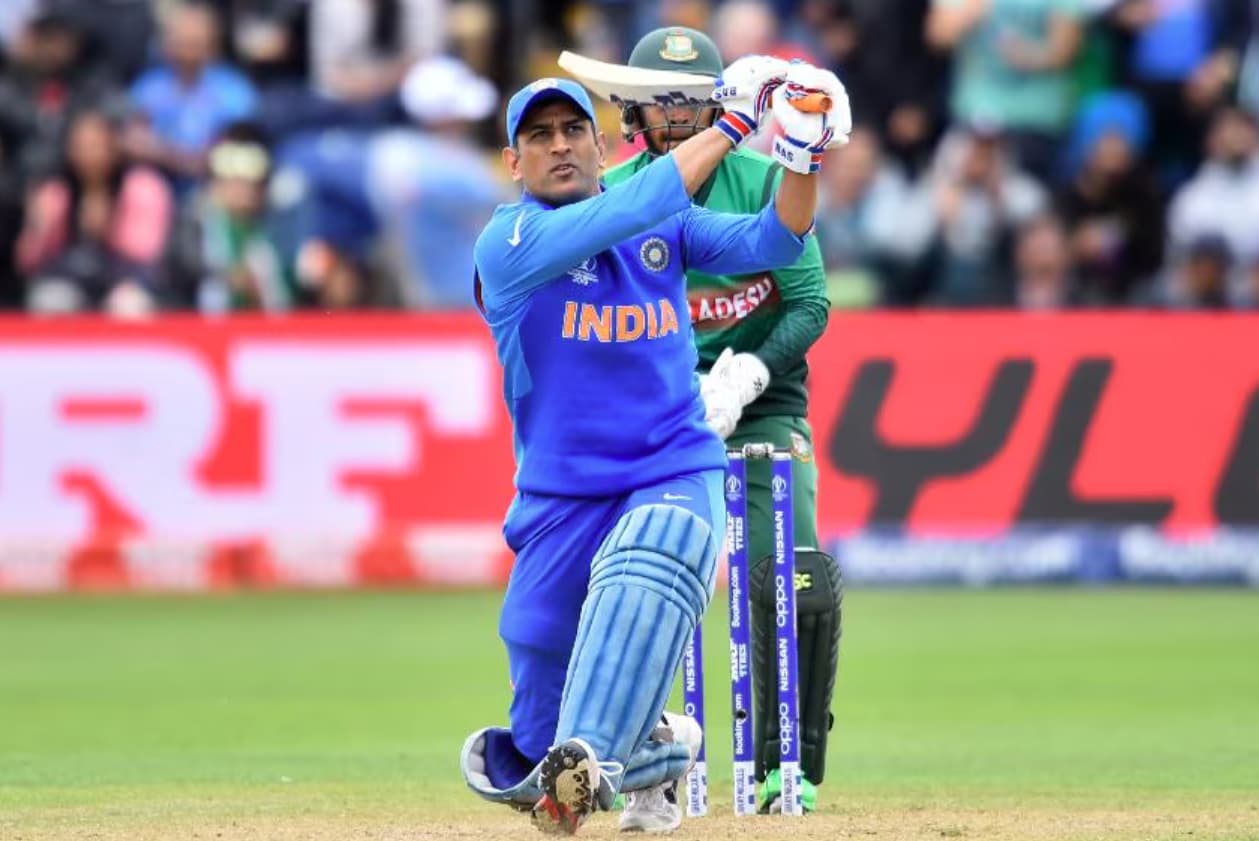
His 108 half-centuries tell the real story—countless times he reached 50s, smashed boundaries to boost totals, and got out attempting aggressive shots for the team’s cause rather than preserving his wicket for individual hundreds.
Dhoni International Career Overview
| Format | Matches | Runs | Average | Strike Rate | Centuries | Half-Centuries | Highest Score |
|---|---|---|---|---|---|---|---|
| Tests | 90 | 4,876 | 38.09 | 59.12 | 6 | 33 | 224 vs AUS (2013) |
| ODIs | 350 | 10,773 | 50.57 | 87.56 | 10 | 73 | 183* vs SL (2005) |
| T20Is | 98 | 1,617 | 37.60 | 126.13 | 0 | 2 | 56 vs ENG (2012) |
| Total | 538 | 17,266 | 44.96 | 88.23 | 16 | 108 | 224 (Test) |
Dhoni’s Century-Making Style: Building Innings From Lower Order
MS Dhoni built innings differently from traditional top-order batsmen who accumulate runs through extended periods at the crease.
He typically walked in when India faced either a crisis (early wickets fallen) or when acceleration was needed (death overs approaching).
His initial approach involved assessing conditions quickly—taking a few balls to gauge pitch behavior and bowling quality—before launching his assault.
Unlike conventional batsmen who gradually shift gears, Dhoni often exploded, going from measured accumulation to boundary-hitting dominance within a few deliveries, catching bowling attacks off-guard.
His finishing role fundamentally shaped how he approached centuries. While top-order batsmen could plan innings around reaching three figures, Dhoni’s job was winning matches regardless of personal milestones.
This meant if India needed 80 runs from 10 overs when he arrived, his focus was maximizing scoring rate to achieve the target, not preserving his wicket to reach a hundred.
Consequently, many of his most valuable innings ended in the 60s, 70s, or 80s—not because he got out carelessly, but because victory arrived before he could accumulate three figures.
His five unbeaten ODI centuries demonstrate this perfectly—in each case, he paced chases so expertly that matches finished with him still batting but short of reaching potential double-hundreds.
The challenges of batting at number six affected his century count significantly.
Unlike openers who face 200+ deliveries regularly, Dhoni often got 40-60 balls maximum in ODIs and walked in during crises in Tests, where tail-enders provided minimal support for extended partnerships.
His batting position meant fewer opportunities to build the patient innings centuries typically require.
Additionally, team management specifically deployed him as a finisher – the player who enters when rapid runs are needed, not when there’s luxury time to build methodical hundreds.
This tactical role maximized India’s winning chances but minimized Dhoni’s century opportunities, making his 16 hundreds even more impressive given the constraints he operated under.
Test Centuries Journey: Six Hundreds That Defined His Red-Ball Career
MS Dhoni’s Test centuries began explosively during India’s 2006 tour of Pakistan, where he announced his Test arrival with a blistering 148 off 153 balls at Faisalabad’s Iqbal Stadium.
Batting at number six in just his fifth Test match, Dhoni’s innings included 19 fours and four sixes—an extraordinarily aggressive strike rate that shocked Pakistan’s quality bowling attack.
This remained his only overseas Test century throughout his career, coming early when he was still establishing himself and before his batting position became fixed in the lower-middle order.
The Faisalabad knock proved he possessed the technique and temperament for Test cricket’s demands, not just explosive hitting from limited-overs formats.
His next five Test centuries all came on Indian soil between 2009 and 2013, reflecting India’s scheduling that saw them play predominantly home Tests during Dhoni’s captaincy.
In 2009, he scored two centuries against Sri Lanka—110 at Ahmedabad’s Narendra Modi Stadium and an unbeaten 100 at Mumbai’s Brabourne Stadium, showcasing his ability to perform consistently against spin-heavy attacks on turning pitches.
These knocks came during his peak period as captain when he balanced leadership responsibilities with maintaining his own batting form, demonstrating remarkable mental strength to compartmentalize different roles.
In 2010, Dhoni crafted an unbeaten 132 against South Africa at Kolkata’s Eden Gardens, proving his capability against quality pace bowling from Dale Steyn, Morne Morkel, and others.
The following year brought 144 against West Indies at the same Kolkata venue—his second Test century at Eden Gardens, proving it as one of his most productive grounds.
However, his crowning Test achievement arrived on February 24, 2013, at Chennai’s MA Chidambaram Stadium, his IPL home ground, where he felt most comfortable.
Facing Australia in what would be his final Test century, Dhoni compiled a magnificent 224, his career-best Test score and one of the highest scores ever by an Indian wicketkeeper.
The marathon innings consumed 265 balls with 24 fours and six sixes, featuring sensible partnerships with Virat Kohli and Ravindra Jadeja.
India won by eight wickets with Dhoni earning the Man of the Match award, providing a fitting final Test hundred before his retirement.
He announced his Test retirement on December 30, 2014, during the Boxing Day Test against Australia in Melbourne, finishing with 4,876 runs at an average of 38.09 across 90 Tests.
Complete MS Dhoni Test Centuries List
| No. | Runs | Opponent | Venue | Date | Balls | 4s/6s | SR | Match Result |
|---|---|---|---|---|---|---|---|---|
| 1 | 148 | Pakistan | Faisalabad | Jan 21, 2006 | 153 | 19/4 | 96.73 | Match Drawn |
| 2 | 110 | Sri Lanka | Ahmedabad | Nov 16, 2009 | – | -/- | – | India Won |
| 3 | 100* | Sri Lanka | Mumbai | Dec 2, 2009 | – | -/- | – | India Won |
| 4 | 132* | South Africa | Kolkata | Feb 14, 2010 | – | -/- | – | India Won |
| 5 | 144 | West Indies | Kolkata | Nov 14, 2011 | – | -/- | – | India Won |
| 6 | 224 | Australia | Chennai | Feb 24, 2013 | 265 | 24/6 | 84.53 | India Won |
ODI Centuries Journey: Ten Hundreds That Built His Limited-Overs Legacy
MS Dhoni ODI centuries provide a more complete picture of his white-ball brilliance, with ten hundreds scored across 12 years from 2005 to 2017.
His first ODI century arrived on April 5, 2005, against Pakistan at Visakhapatnam’s Dr. YS Rajasekhara Reddy Cricket Stadium, where he demolished the attack with 148 runs off 123 balls featuring 15 fours and four sixes.
This innings announced his arrival as a genuine match-winner, showcasing aggressive intent and clean hitting that would define his career.
The Pakistani bowlers had no answers as Dhoni repeatedly cleared boundaries with minimal footwork, relying purely on timing and power.
Just six months later, on October 31, 2005, Dhoni produced his career-best ODI score—an unbeaten 183 against Sri Lanka at Jaipur’s Sawai Mansingh Stadium.
This demolition featured 15 fours and 10 sixes, with several clearing the stadium entirely and landing on nearby roads.
This knock broke multiple records and established Dhoni as one of world cricket’s most dangerous batsmen.
The innings became legendary in Indian cricket folklore, with fans still discussing individual sixes that traveled unprecedented distances.
This remains the highest score by any Indian wicketkeeper in ODI cricket.
The 2007-2010 period marked Dhoni’s peak years for scoring centuries. During the 2007 Afro-Asia Cup, he crafted an unbeaten 139 against the Africa XI at Chennai, demonstrating his ability to pace innings perfectly.
In 2008, facing Hong Kong at Karachi, he partnered with Suresh Raina for a destructive 166-run stand, scoring an unbeaten 109.
The year 2009 proved his most prolific three centuries, including 124 against Australia in Nagpur (breaking a seven-match losing streak), 107 against Sri Lanka at the same venue, and an unbeaten 101 against Bangladesh in Dhaka.
His later ODI centuries retained their quality despite his advancing age. In 2012, he scored an unbeaten 113 against Pakistan in Chennai in high-pressure circumstances.
The following year brought another unbeaten 139 against Australia in Mohali. Finally, on January 19, 2017, at age 35, Dhoni scored his tenth and final ODI century, 134 against England at Cuttack’s Barabati Stadium.
This hundred came after nearly four years without a century, proving that even in his career’s twilight, Dhoni could produce match-winning knocks when India needed them.
Each century demonstrated his versatility—some explosive from the start, others patient accumulations—but all showcased his match awareness and finishing abilities.
Complete MS Dhoni ODI Centuries List
| No. | Runs | Opponent | Venue | Date | Balls | 4s/6s | SR | Result |
|---|---|---|---|---|---|---|---|---|
| 1 | 148 | Pakistan | Visakhapatnam | Apr 5, 2005 | 123 | 15/4 | 120.32 | India Won |
| 2 | 183* | Sri Lanka | Jaipur | Oct 31, 2005 | 145 | 15/10 | 126.21 | India Won |
| 3 | 139* | Africa XI | Chennai | Jun 10, 2007 | – | -/- | – | India Won |
| 4 | 109* | Hong Kong | Karachi | Jun 25, 2008 | – | 6/- | – | India Won |
| 5 | 124 | Australia | Nagpur | Oct 28, 2009 | – | 9/3 | – | India Won |
| 6 | 107 | Sri Lanka | Nagpur | Dec 18, 2009 | – | -/- | – | India Won |
| 7 | 101* | Bangladesh | Dhaka | Jan 7, 2010 | 107 | 9/0 | 94.39 | India Won |
| 8 | 113* | Pakistan | Chennai | Dec 30, 2012 | 125 | -/- | 90.40 | India Won |
| 9 | 139* | Australia | Mohali | Oct 19, 2013 | – | -/- | – | India Won |
| 10 | 134 | England | Cuttack | Jan 19, 2017 | 122 | 10/6 | 109.84 | India Won |
Dhoni’s Century Record: Home vs Overseas Analysis
When analyzing MS Dhoni centuries in India, the statistics reveal that 13 of his 16 international hundreds came on home soil—a pattern common among players worldwide who naturally perform better in familiar conditions.
In Tests, five of his six centuries were scored across Indian venues: two at Kolkata’s Eden Gardens (against South Africa and West Indies), one each at Ahmedabad and Mumbai (both against Sri Lanka), and his monumental 224 at Chennai against Australia.
His eight ODI centuries in India spread across Visakhapatnam, Jaipur, Chennai (two), Nagpur (two), Mohali, and Cuttack, demonstrating his ability to perform consistently regardless of specific pitch conditions—whether pace-friendly, spin-friendly, or flat batting tracks.
Examining MS Dhoni centuries in Overseas locations reveals more modest numbers—just three centuries away from India, all within Asia.
His 148 in Faisalabad, Pakistan, remains his only overseas Test century, coming early in his career during his explosive introduction to Test cricket.
In ODIs, he scored two overseas hundreds: 109 not out against Hong Kong in Karachi (2008) and 101 not out against Bangladesh in Dhaka (2010).
Notably, Dhoni never scored a century outside Asia throughout his entire 538-match career—no hundreds in Australia, England, South Africa, West Indies, or New Zealand.
Critics pointed to this as a weakness, but supporters emphasized his finishing role meant rarely having sufficient deliveries to build centuries overseas, and his impact through crucial 50s and 60s extended far beyond personal hundreds.
Home vs Away Century Comparison
| Location | Test | ODI | Total | Best Score | % of Total |
|---|---|---|---|---|---|
| Home (India) | 5 | 8 | 13 | 224 vs AUS | 81.25% |
| Asia (Away) | 1 | 2 | 3 | 183* vs SL (at neutral venue) | 18.75% |
| Non-Asia | 0 | 0 | 0 | – | 0% |
Dhoni in T20I Format: The Missing Hundreds
When examining MS Dhoni T20 centuries, the number stands at zero despite playing 98 T20 Internationals—a statistic initially surprising but logical upon understanding his role.
In T20 cricket, Dhoni typically batted at number six or seven, often walking in with just 20-30 balls remaining in India’s 120-ball innings.
His job was never building centuries but maximizing runs in minimal deliveries through boundaries, aggressive running, and calculated risks that got India to competitive totals.
The T20 format’s structure makes centuries extraordinarily rare for middle and lower-order batsmen, as top-order players consume 80-90 balls, leaving finishers with insufficient deliveries to reach three figures even with perfect execution.
His T20I statistics—1,617 runs at a strike rate of 126.13 with a highest score of 56—reflect his effectiveness despite lacking centuries.
His T20 legacy rests not on hundreds but on countless match-winning knocks in the 20s through 40s, where he finished games with overs remaining, often staying unbeaten, having paced chases perfectly.
This approach revolutionized finishing roles globally, inspiring a generation prioritizing team success over personal statistics.
Extra Highlights, Records & Lasting Impact
Beyond MS Dhoni Total Centuries, his career is defined by unprecedented captaincy achievements transcending individual batting statistics.
His captaincy records include leading India in 332 matches across formats (60 Tests, 200 ODIs, 72 T20Is), winning 178—the most by any Indian captain.
He remains the only captain in cricket history to win all three major ICC trophies: the 2007 T20 World Cup (debut as captain), 2011 ODI World Cup at home, and 2013 Champions Trophy.
Under his leadership, India achieved the number one Test ranking, maintaining it for 18 months from 2009.
His finisher performances define why centuries alone cannot measure his value.
The “Best Finisher of India” tag reflects countless ODI chases where he remained unbeaten in the 60s, 70s, or 80s, having paced innings so perfectly that victory arrived with overs remaining.
The 2011 World Cup final epitomizes this—his 91 not out fell nine runs short of a century but delivered India’s second World Cup title with a six.
His 84* in the 2011 semi-final against Sri Lanka, numerous unbeaten 70s in bilateral series, and countless 60s in successful chases enhanced rather than diminished his reputation because they proved he valued winning over personal milestones.
His IPL influence with Chennai Super Kings further cemented his legacy, leading them to multiple championships and establishing himself as T20 cricket’s most successful captain.
His mentoring of young players like Virat Kohli, Rohit Sharma, Ravindra Jadeja, Hardik Pandya, and others shaped India’s next generation.
His famous “helicopter shot,” calm demeanor during crises, lightning-fast stumpings (holding the record for most ODI stumpings with 123), and tactical brilliance created a legacy that statistical categories like “centuries” simply cannot capture adequately.
Conclusion: A Legacy Beyond Hundreds
MS Dhoni Total Centuries—16 across Tests and ODIs with zero in T20Is—represents just one narrow dimension of a legacy that transformed Indian cricket fundamentally.
His ten ODI hundreds and six Test centuries came in crucial matches under immense pressure, frequently in partnerships where he elevated teammates through calmness and tactical wisdom.
The relatively modest century count reflects not batting limitations but the selfless lower-order role he embraced, sacrificing personal milestones to maximize team success through rapid scoring in limited deliveries.
Also Check:
- Who Was The First Player To Be Given Out By The Third Umpire
- Who Saved Virat Kohli Career
- IPL Winning Captains List 2008 to 2025
- Chennai Super Kings IPL 2026 Retained & Released Players List
- Harrdy Sandhu Cricket Career
- Longest Sixes In Cricket History
- Why CSK Was Banned for 2 Years
About the Author
