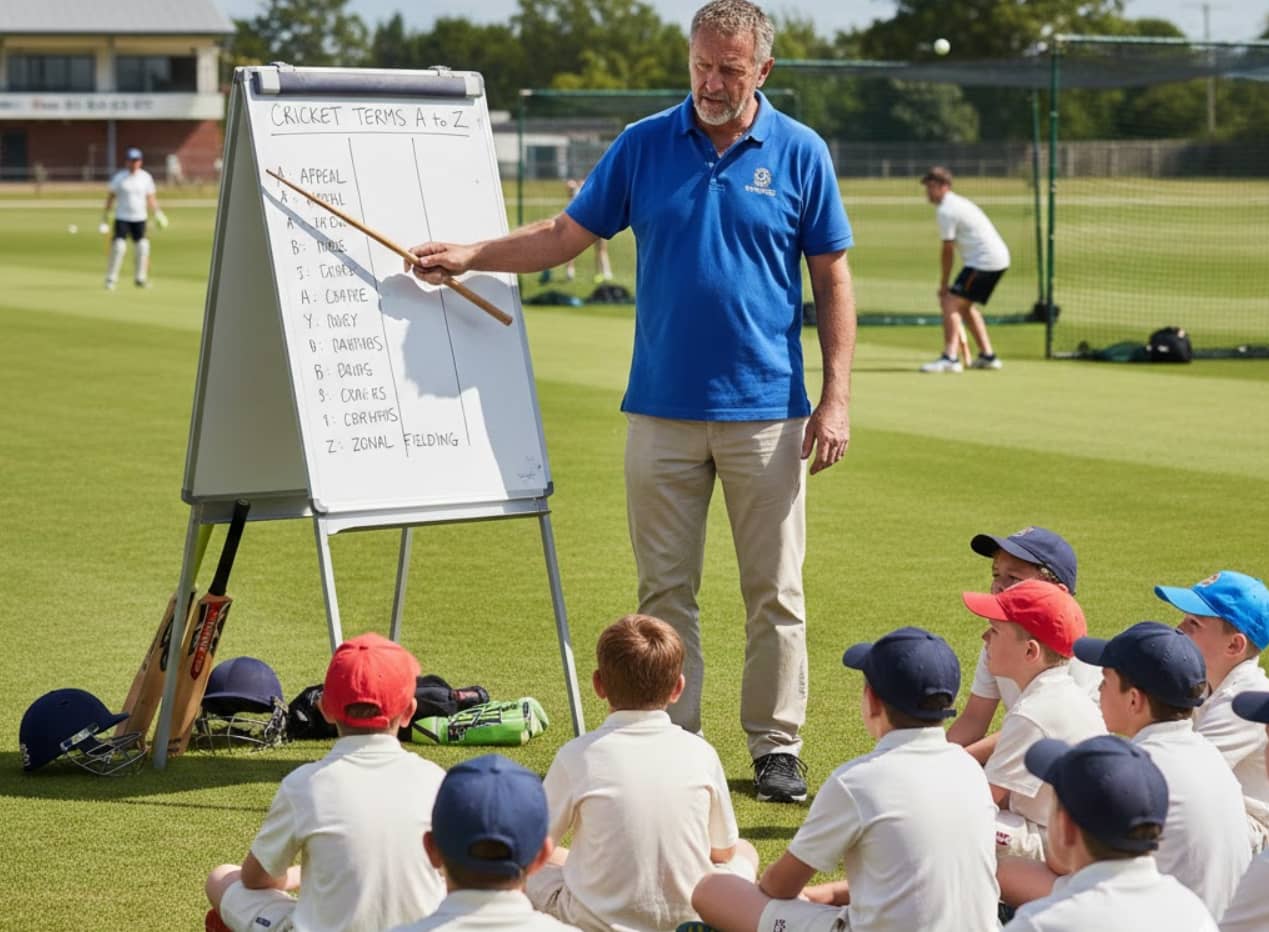
Cricket uses words that confuse new fans. The commentary mentions LBW, googly, and silly point without explaining them.
Beginners struggle to follow matches because of this language barrier. This reference guide solves that problem.
It lists cricket terms A to Z with clear meanings and match examples.
Each term gets a short definition and a real usage context.
The alphabetical format makes finding any word quick and simple.
Cricket Terms A to Z
Cricket Terms Glossary: Full List with Examples This glossary covers batting, bowling, fielding, and match terms. Terms are sorted alphabetically from A to Z.
Each letter section contains 8-10 commonly used words. Definitions stay under two lines. Examples show how each term appears in actual cricket matches.
Why Understanding Cricket Terminology Matters? Cricket language helps you:
Follow live commentary without confusion Read scorecards and match reports accurately Understand tactical decisions during games Discuss matches with other cricket fans Learn the rules and scoring system faster Knowing basic terms makes watching cricket more enjoyable.
20 Common Cricket Terms for Beginners Term Simple Meaning Wicket The three stumps or a dismissal Over Six legal balls bowled Run Basic scoring unit LBW Leg Before Wicket dismissal Boundary Four or six runs Six Ball clears boundary in air Four Ball reaches boundary after bouncing Catch Fielder grabs ball before it lands Innings Team’s batting turn Pitch Playing strip between stumps Crease Marked line for run decisions Spin Bowling that turns the ball Fast Bowling High-speed delivery All-rounder Player who bats and bowls Partnership Runs by two batters together Duck Out for zero runs Powerplay Overs with fielding limits Review Video replay challenge No-ball Illegal delivery Free Hit Cannot be out after no-ball
A–Z Cricket Terminology Glossary A Terms Term Meaning Match Example Across the Line Bat swings sideways to ball path Batter plays across line and gets bowled Action Bowler’s movement during delivery Smooth action helps control Agricultural Shot Hard swing with poor technique Hit towards cow corner All Out Batting side has 10 dismissals India all out for 245 Anchor Batter who stays long at crease Pujara anchored the innings Appeal Request for umpire decision Fielders appeal for LBW Arm Ball Spinner’s straight delivery Arm ball trapped the batter Around the Wicket Bowling from opposite side Bowler switches around wicket Ashes England vs Australia Test series Australia retained the Ashes Asking Rate Required runs per over Asking rate is 8.5 per over
B Terms Term Meaning Match Example Back Foot Foot nearest to stumps Played off the back foot Backlift Bat raised before shot High backlift generates power Bad Light Too dark to see ball Play stopped due to bad light Bail Small piece on stumps Bail fell off the stumps Ball Tampering Illegally altering ball Player banned for ball tampering Bat-Pad Close fielder on leg side Caught at bat-pad Beamer Full toss above waist Bowler warned for beamer Beat the Bat Ball misses bat edge Bowler beat bat three times Boundary Field edge or four/six runs Ball crossed the boundary Bouncer Short ball at chest height Fast bouncer at 145 km/h
C Terms Term Meaning Match Example Call Shout between batters for runs “Yes” call led to quick single Captain Team leader Captain won the toss Carrom Ball Flicked spin delivery Carrom ball deceived batter Catch Ball held before touching ground Easy catch at mid-off Caught Behind Caught by wicketkeeper Edged and caught behind Century 100 runs in one innings Kohli scored his 50th century Cherry Red cricket ball New cherry swinging Chinaman Left-arm wrist spin Chinaman turned sharply Clean Bowled Ball hits stumps directly Clean bowled through the gate Collapse Multiple quick wickets Team collapsed from 150/2 to 180 all out
D Terms Term Meaning Match Example Dead Ball Ball not in play Umpire called dead ball Dead Bat Soft defensive shot Played with dead bat Death Overs Final overs of innings Scored 60 in death overs Declaration Captain ends innings early Australia declared at 450/7 Deep Fielder near boundary Deep square leg caught it Delivery Single ball bowled First delivery was a yorker Dismissal Batter getting out Third dismissal was run out Dolly Easy catch Dropped a dolly at slip Doosra Off-spin turning opposite way Doosra surprised the batter Dot Ball No runs scored Five dot balls in the over
E Terms Term Meaning Match Example Economy Rate Runs per over by bowler Economy rate of 4.5 Edge Ball hits bat side Thick edge to slips Eleven Team of 11 players Playing eleven announced End Side of pitch for bowling Bowling from pavilion end Extras Runs not from bat 15 extras in the innings
F Terms Term Meaning Match Example Fall of Wicket When dismissal happened First wicket fell at 35 Fast Bowler High-speed bowler Fast bowler clocked 150 km/h Feather Faint edge Feathered to keeper Fielder Player stopping runs Fielder saved four runs Fielding Circle 30-yard marked area Two fielders outside circle Fifty 50 runs scored Quick fifty in 28 balls Fifer Five wickets in innings Took a fifer in first innings Fine Leg Position behind keeper Ball went to fine leg Flight High loop on ball Given flight to deceive Follow-On Bat again immediately Enforced the follow-on
G Terms Term Meaning Match Example Gardening Patting pitch between balls Batter gardening the pitch Glance Deflected shot to leg Glanced down to fine leg Googly Leg-spin turning opposite Googly bowled him Good Length Difficult bounce spot Bowled good length all over Guard Batting alignment mark Takes middle-and-leg guard Gully Fielder between slip and point Caught at gully
H Terms Term Meaning Match Example Half Century 50-99 runs Half century in 45 balls Half Volley Easy driving length Drove half volley for four Hat-Trick Three wickets in three balls Bowler completed hat-trick Hawk-Eye Ball tracking technology Hawk-Eye showed hitting stumps Heavy Ball Feels harder than speed shows Heavy ball rushed the batter Helmet Head protection Helmet saved him from bouncer Hit Wicket Batter breaks own stumps Out hit wicket stepping back Hook Shot Pull to short ball Hooked for six over square leg Hot Spot Thermal imaging tool Hot Spot showed edge
I Terms Term Meaning Match Example Infield Area inside 30-yard circle Infield up for pressure In-Swinger Ball swings towards body In-swinger trapped LBW Inside Edge Ball hits bat inside Inside edge onto pads Innings Team’s batting period First innings total 320 Intent Aggressive approach Showed positive intent
J Terms Term Meaning Match Example Jaffa Unplayable delivery Absolute jaffa beat him Jag Back Ball moves in sharply Jagged back to hit stumps
K Terms Term Meaning Match Example Keeper Wicketkeeper Keeper took brilliant catch King Pair Out first ball both innings Suffered a king pair Knock Batting performance Played match-winning knock Knuckle Ball Slower ball with knuckles Knuckle ball deceived batter
L Terms Term Meaning Match Example Late Cut Delicate cut shot Late cut past slip for four LBW Leg Before Wicket Given out LBW on review Leg Break Spin from leg to off Leg break turned past bat Leg Bye Run off body not bat Two leg byes taken Length Where ball bounces Good length bowling Line and Length Accuracy in bowling Maintained tight line and length Long Hop Short easy ball Long hop pulled for six Long On/Off Deep straight fielders Caught at long on
M Terms Term Meaning Match Example Maiden Over No runs scored Bowled three maiden overs Mankad Run out non-striker early Mankad dismissal caused debate Middle Order Batters 4-7 Middle order collapsed Misfield Fielding error Misfield gave extra runs
N Terms Term Meaning Match Example Nets Practice area Training in the nets Nightwatchman Lower-order sent to protect Sent nightwatchman before stumps No-Ball Illegal delivery Overstepped for no-ball Nurdle Soft shot for singles Nurdled around for singles
O Terms Term Meaning Match Example Off Break Spin from off to leg Off break spun sharply Off Drive Drive through off side Cover drive for four On Drive Drive towards mid-on Straight on drive Opener First two batters Openers gave solid start Outfield Area outside circle Fast outfield helped boundaries Outswinger Ball swings away Outswinger found edge Over Six legal deliveries Final over needed 12 runs Overthrows Extra runs from misfield Four overthrows
P Terms Term Meaning Match Example Pad Leg protection Ball hit pad not bat Pair Out for zero both innings Registered a pair Partnership Combined runs by two batters 150-run partnership Pavilion Players’ building Walking back to pavilion Pitch Playing surface Batting-friendly pitch Point Off-side square fielder Fielding at point Powerplay Limited fielding restrictions Scored 50 in powerplay Pull Shot Horizontal bat to short ball Pulled for six
Q Terms Term Meaning Match Example Quick Single Fast run taken Sharp quick single
R Terms Term Meaning Match Example Rabbit Poor batter Typical rabbit dismissed Reverse Sweep Sweep in opposite direction Reverse swept for four Reverse Swing Old ball swings opposite Reverse swing got wicket Run Out Batter out running Run out by direct hit Run Rate Runs per over Run rate of 6.5
S Terms Term Meaning Match Example Seam Stitched part of ball Landed on the seam Short Leg Close leg-side fielder Caught at short leg Silly Point Very close off-side fielder Silly point took sharp catch Single One run scored Rotated strike with singles Six Ball clears boundary in air Massive six over mid-wicket Slip Behind-keeper catching position First slip took catch Slower Ball Reduced pace delivery Slower ball deceived batter Spin Turn on ball Getting turn and bounce Square Leg Side-on leg fielder Umpire at square leg Strike Rate Runs per 100 balls Strike rate of 145 Stump Three vertical posts Ball hit middle stump Stumping Keeper removes bails Stumped down leg side Sweep Horizontal shot on leg Swept fine for four
T Terms Term Meaning Match Example Tailender Lower-order batter Tailenders added 30 runs Target Runs needed to win Target of 280 set Tea Break Afternoon interval Play resumes after tea Third Man Deep off-side behind keeper Ball raced to third man Third Umpire Video replay official Referred to third umpire Tie Both teams same score Match ended in tie Timing Perfect bat-ball contact Beautiful timing on shot Top Edge Ball hits bat top Top edge fell safe Toss Coin flip before match Won toss and elected to bat Twenty20 20-over format T20 match finished early
U Terms Term Meaning Match Example Umpire On-field official Umpire raised finger Umpire’s Call Marginal DRS decision Stayed with umpire’s call Upper Cut Shot over slips Upper cut for six
V Terms Term Meaning Match Example V Straight scoring area Hit through the V Variation Changed delivery Bowled clever variation
W Terms Term Meaning Match Example Wagon Wheel Run distribution graphic Wagon wheel showed scoring areas Wicket Stumps, dismissal, or pitch Lost three quick wickets Wicketkeeper Behind-stumps fielder Keeper standing up Wide Ball too far from batter Called wide down leg Yorker Ball at feet Perfect yorker bowled him
X Terms Term Meaning Match Example Xtra Cover Between cover and mid-off Fielding at extra cover
Y Terms Term Meaning Match Example Yorker Delivery at batter’s toes Toe-crushing yorker
Z Terms Term Meaning Match Example Zing Bails LED light-up bails Zing bails lit up Zone Peak batting form Batter in the zone
Field Positions with Diagrams Cricket field positions have unique names based on location and distance.
Close Fielders: Slip, gully, silly point, short leg, leg slip. These catch edges and deflections.Inner Circle: Point, cover, mid-off, mid-on, square leg. They stop at singles and drives.Boundary Riders: Third man, fine leg, deep square, long-on, long-off. They save boundaries and take skied catches.Right-handed batters face different field setups than left-handers. Captains adjust positions based on bowling type and match situation.
Batting Terminology Term Usage Cover Drive Front foot shot through covers Straight Drive Hit past bowler down ground Pull Shot Horizontal bat to short ball Sweep Low shot along ground on leg Reverse Sweep Sweep in opposite direction Cut Shot Back foot shot square off side Hook Aggressive pull to bouncer Lofted Shot Hit in air over fielders
Bowling Terminology Term Usage Yorker Pitched at batter’s feet Bouncer Short ball at chest/head Off Break Right-arm spin into batter Leg Break Right-arm spin away from batter Googly Leg-spin opposite turn In-Swinger Ball curves towards body Outswinger Ball curves away Slower Ball Pace reduced to deceive
Dismissal Types Method How It Happens Bowled Ball hits stumps Caught Fielder catches before bounce LBW Ball hits pad, would hit stumps Run Out Stumps broken while running Stumped Keeper breaks stumps, batter out Hit Wicket Batter breaks own stumps Caught and Bowled Bowler catches own delivery Obstructing Field Batter blocks fielder deliberately Handled Ball Touches ball with hand illegally Timed Out Takes too long to arrive
Scoring and Match Progress Term Explanation Run Rate Average runs per over Strike Rate Batter’s runs per 100 balls Economy Rate Bowler’s runs per over Net Run Rate Tournament ranking calculation Partnership Combined runs by two batters Powerplay First 10 overs with fielding limits Death Overs Final overs of limited innings Maiden Over Zero runs scored
Equipment Terms Item Purpose Bat Hitting the ball Ball Bowled at batter Pads Leg protection Gloves Hand protection Helmet Head protection Box Groin protection Stumps Three vertical posts Bails Sit on top of stumps Sight Screen Background for seeing ball
Match Formats and Rules Test Cricket: Five days, two innings per team. The longest format tests stamina and technique.ODI: 50 overs per side. A balance between patience and aggression is needed.T20: 20 overs per side. Fast-paced format rewards big hitting.The Hundred: 100 balls per side. Used in England, different from traditional formats.DLS Method: Adjusts targets in rain-affected games. A complex mathematical formula is used.Also Check: 15 Rules of Cricket
Cricket Slang & Commentary Lingo Common phrases heard during matches:
Golden Duck: Out first ballKing Pair: Out first ball both inningsJaffa: Unplayable deliveryDolly: Easy catchBunny: Batter who gets out to same bowler oftenNightwatchman: Lower-order batter protecting better playerSledging: Verbal tactics to distract opponentChin Music: Bouncers aimed at headCherry: New red ballMeat of the Bat: Middle of bat bladeRegional Variations in Cricket Terminology England: Traditional terms like “spinner,” “pavilion,” “county cricket”Australia: “Baggy green” for Test cap, “the ashes,” casual nicknamesIndia: “Doosra,” “carrom ball” popular due to spin culture. Hindi cricket commentary uses many English terms.West Indies: “Calypso cricket” describes entertaining styleSouth Africa: “Proteas” team nickname, “quota system” discussionsPakistan: “Reverse swing” mastery, Urdu commentary termsDifferent countries emphasize different aspects based on their cricket traditions and playing conditions.
History and Origins of Key Terms Googly: Invented in late 1800s by Bernard Bosanquet. Named for the surprised reaction it caused.Yorker: Believed to originate from Yorkshire bowlers who perfected this delivery in the 1800s.Hat-Trick: Started in 1858 when a bowler received a hat for taking three wickets in three balls.Ashes: Began in 1882 after England lost to Australia at home. Newspaper joked English cricket had died and “ashes” would go to Australia.Sticky Wicket: From uncovered pitches era. Rain made batting nearly impossible on drying pitches.Mankad: Named after Vinoo Mankad who ran out a non-striker backing up too far in 1947.FAQs What does LBW mean in cricket? Leg Before Wicket. Batter is out when ball hits pad and would have hit stumps.
How many ways can a batter get out? Ten official dismissal methods exist in cricket rules.
What is the difference between Test and T20 cricket? Tests last five days with two innings each. T20 has 20 overs per side and finishes in three hours.
Zero looks like a duck’s egg shape. Getting out for zero is called a duck.
What does economy rate mean? Average runs a bowler gives per over. Lower economy is better bowling performance.
What is a yorker delivery? Ball pitched right at the batter’s feet in the blockhole. Very hard to hit.
How does the powerplay work? First 10 overs in ODI with only two fielders outside the 30-yard circle. Creates more boundary chances.
Decision Review System. Teams can challenge umpire decisions using video technology and ball tracking.
Why do batters take guard? To align themselves with the stumps. Common guards are leg, middle, or middle-and-leg.
What makes a pitch batting-friendly? Hard, flat surface with even bounce and no cracks. Ball comes onto bat nicely for scoring.
Conclusion Learning cricket vocabulary helps you follow matches better. This Cricket Glossary A to Z covers batting, bowling, fielding, and scoring terms. Each term includes a match context example.
Key sections cover:
Alphabetical term definitions Field positions and their roles Batting and bowling categories Dismissal methods Match format differences Regional cricket language Historical term origins The table format makes finding any term quick. Simple definitions work for beginners and students.
Understanding these cricket terms a to z improves your match viewing experience.
Use this guide whenever you hear unfamiliar cricket words during commentary or in match reports.
Post navigation