The Greenfield International Stadium in Thiruvananthapuram, Kerala, has established itself as a venue where bowlers hold a distinct advantage across all formats.
Understanding the Greenfield International Stadium records in T20Is, odi, and tests with the current pitch report helps teams strategize effectively before taking the field.
The stadium, with a seating capacity of 50,000, has hosted limited matches since its first international fixture in 2018, yet the trends remain clear.
Teams bowling first have historically dominated here, with chasing sides winning 9 out of 14 completed matches.
The pitch characteristics, boundary dimensions, and local weather conditions all contribute to the bowling-friendly nature of this venue.
Greenfield International Stadium Records and Pitch Report
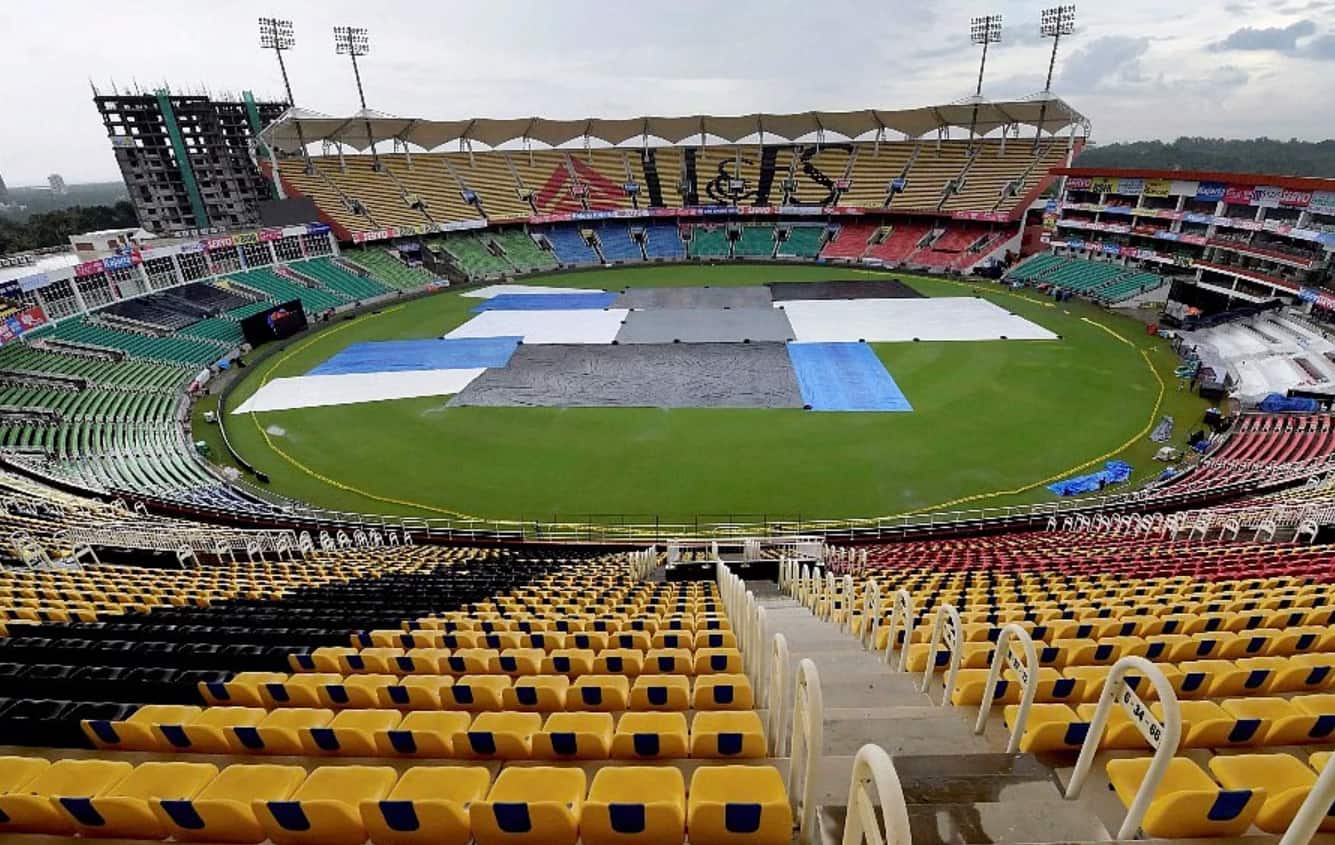
Greenfield International Ground Pitch Report
| Aspect | Details |
|---|---|
| Surface Type | Grass |
| Nature | Bowling-friendly |
| Assistance | Seam early, spin later |
| Average Bounce | Consistent |
| Scoring Pattern | Low to moderate |
- Early Movement for Pace Bowlers: The pitch offers significant assistance to seamers with the new ball, particularly during overcast conditions common in Thiruvananthapuram. Fast bowlers extract lateral movement and consistent bounce, forcing batsmen to play cautiously during the powerplay overs.
- Spinners Gain Control in Middle Overs: As the match progresses, the surface begins to grip, allowing spinners to extract turn and bounce. Both finger spinners and wrist spinners find purchase, especially from the 10-over mark onwards in limited-overs formats.
- Challenging Conditions for Aggressive Batting: Batsmen struggle to score freely throughout the innings due to the dual threat of pace and spin. The pitch demands technical proficiency rather than power-hitting, with stroke-makers needing to work harder for boundaries.
- Second Innings Advantage Evident: Despite being bowling-friendly, teams batting second have enjoyed greater success. The pitch tends to settle slightly under lights, and dew factor occasionally neutralizes spin bowling in the latter half of matches.
Greenfield International Ground Dimensions
| Boundary Direction | Approx Length |
|---|---|
| Leg Side | Varies |
| Off Side | Varies |
| Straight | Longer than square |
| Behind Square | Shorter |
The boundary dimensions at Greenfield International Stadium favor bowlers due to longer straight boundaries compared to square boundaries.
Batsmen attempting to clear the fence down the ground face additional challenges, making lofted shots over mid-off and mid-on riskier propositions.
Square boundaries on both legs and off-sides offer slightly shorter distances, making sweeps, pulls, and cuts more productive scoring options.
However, the bowling-friendly nature of the pitch often restricts batsmen from playing these aggressive strokes with confidence.
Greenfield International Cricket Stadium Records and Venue Stats: T20, T10, ODI, Test
| Format | Matches | Avg 1st Inns | Highest Total | Lowest Total |
|---|---|---|---|---|
| T20 | 4 | 144 | 235 | 67 |
| ODI | 4 | 144 | 235 | 67 |
| Test | 2 | 247 | 390 | 73 |
The venue statistics across formats reveal consistent bowling dominance.
First innings averages remain moderate in white-ball cricket at 144, while Test matches show higher first innings scores averaging 247 runs.
The highest totals recorded demonstrate that batting collapses occur frequently at this venue.
The lowest defended score of 67 in T20/ODI cricket and 73 in Test matches highlights how effectively bowling attacks can exploit conditions here.
Greenfield International Cricket Stadium Records in T20I
| Stat | Value |
|---|---|
| Total Matches | 4 |
| Matches Won Batting First | 2 |
| Matches Won Bowling First | 2 |
| Average 1st Innings Score | 144 |
| Average 2nd Innings Score | 133 |
| Highest Total | 235 |
| Highest Score Chased | 173 |
| Lowest Score Defended | 67 |
- Balanced Toss Impact in T20 Format: T20 matches show an even split between teams batting and bowling first, winning, with 2 victories each. This suggests a toss advantage exists, but execution matters more than the decision itself.
- Below-Par Scoring Rates: The average first innings score of 144 remains significantly below typical T20 standards. Teams consistently struggle to post competitive totals, with bowling attacks maintaining control throughout 20 overs.
- Chasing Record Shows Vulnerability: The highest successfully chased score stands at 173, indicating teams batting second also face difficulties. The Greenfield International Stadium records in T20Is, odi, and tests with the current pitch report confirm this pattern across all formats.
Greenfield International Cricket Stadium Records in ODIs
| Stat | Value |
|---|---|
| Total Matches | 4 |
| Matches Won Batting First | 2 |
| Matches Won Bowling First | 2 |
| Average 1st Innings Score | 144 |
| Average 2nd Innings Score | 133 |
| Highest Total | 235 |
| Highest Score Chased | 173 |
| Lowest Score Defended | 67 |
- Toss Strategy Remains Flexible: ODI matches mirror T20 results with an equal split of 2-2 between teams choosing to bat or bowl first. Captains winning the toss have shown varied approaches based on match situations and team compositions.
- Chasing Teams Hold Slight Edge: Historical data indicates teams batting second have won 9 out of 14 matches across formats at this venue. The pitch conditions tend to improve marginally under lights, giving chasers a tactical advantage.
- Low-Scoring Affairs Dominate: The average first innings score of 144 in ODI format suggests severely restrictive conditions. Batting lineups fail to build substantial partnerships, with regular wickets preventing momentum throughout innings.
Greenfield International Cricket Stadium Records in Test
| Stat | Value |
|---|---|
| Total Matches | 2 |
| Matches Won Batting First | 1 |
| Matches Won Bowling First | 1 |
| Average 1st Innings Score | 247 |
| Average 2nd Innings Score | 89 |
| Highest Total | 390 |
| Lowest Total | 73 |
| Highest Score Chased | 105 |
| Lowest Score Defended | 390 |
- Batting Collapses Define Test Cricket: The average second innings score of 89 compared to the first innings score of 247 highlights severe deterioration in batting conditions. Teams batting last face extreme challenges as the pitch wears significantly.
- Fourth Innings Chases Nearly Impossible: The highest successful chase of 105 demonstrates how difficult batting becomes in the final innings. The Greenfield International Stadium records in T20Is, odi, and test with the current pitch report, show consistent bowling dominance.
- First Innings Totals Prove Decisive: With the lowest score defended standing at 390, teams posting substantial first innings totals hold commanding positions. The pitch assists bowlers progressively, making recovery from poor starts nearly impossible.
Greenfield International Stadium: Is Batting Pitch Or Bowling Pitch?
The Greenfield International Stadium favors bowling with a 60-40 split over batting. Fast bowlers extract movement early while spinners dominate the middle and latter phases across all formats.
- Seam Movement Dominates Early Overs: The grass covering provides significant assistance to pace bowlers during the initial overs. New ball bowlers consistently trouble batsmen with lateral movement and variable bounce, leading to frequent early wickets.
- Spin Bowling Becomes Lethal: As matches progress, the pitch offers increasing grip and turn for spinners. Both orthodox and unorthodox spinners find success, making stroke-making increasingly difficult as innings develop.
- Batsmen Struggle Throughout: Scoring rates remain consistently below format averages across T20, ODI, and Test cricket. The Greenfield International Stadium records in T20Is, odi, and test with the current pitch report confirming minimal batting-friendly characteristics.
Type Of Pitch
- New Ball Phase Characteristics: The opening 10 overs in limited-overs cricket and the first session in Tests see maximum assistance for seamers. Overcast conditions amplify swing, while consistent bounce allows bowlers to maintain disciplined lines.
- Middle Overs Transition: From the 10-15 over mark in white-ball cricket, the pitch begins offering turn. Batsmen face dual challenges of pace and spin, making boundary-hitting difficult and requiring rotational strike-management.
- Death Overs and Final Sessions: The pitch maintains its challenging nature throughout matches. Unlike typical venues where batting becomes easier late in innings, Greenfield Stadium continues assisting bowlers, with spinners maintaining control and pace bowlers returning effectively.
Weather Report & Forecast
- Humidity Factor: Thiruvananthapuram experiences high humidity levels year-round, contributing to swing bowling conditions. The moisture-laden atmosphere helps seamers extract movement, particularly during morning and evening sessions.
- Rain Interruption Possibilities: The coastal location makes the venue susceptible to sudden rain showers, especially during monsoon months. Teams must prepare for potential match stoppages and revised target calculations under the DLS method.
- Swing Assistance Throughout: The combination of grass covering and humid conditions creates ideal swing bowling environments. Both conventional and reverse swing come into play, giving bowlers multiple attacking options across match phases.
- Dew Impact on Night Matches: Evening matches occasionally witness dew affecting the second innings, particularly in limited-overs formats. This factor can neutralize spin bowling to some extent, providing marginal relief to chasing teams.
Conclusion:
The Greenfield International Stadium records in T20Is, odi, and tests with the current pitch report, establishing this venue as distinctly bowling-friendly across all formats.
Teams must prioritize building quality bowling attacks over batting depth when playing here.
- Pitch Heavily Favors Bowlers: Seamers and spinners both find consistent assistance, with the surface offering movement, bounce, and turn throughout matches. Batting requires exceptional technique and patience.
- Chasing Teams Hold Statistical Edge: Despite bowling-friendly conditions, teams batting second have won 9 of 14 matches. Captains winning tosses should consider bowling first to exploit early conditions.
- Low Scores Remain Competitive: Totals around 140-150 in white-ball cricket and 250 in Tests prove defendable. Teams should adjust expectations and build innings conservatively rather than aggressively.
About the Author
