The Dubai International Cricket Stadium pitch report reveals a balanced surface that adapts through different phases of play.
Located within Dubai Sports City, this venue has hosted over 190 international matches since 2009 across all formats.
The pitch offers early assistance to pacers, transitions into a spin-friendly middle phase, and often favors chasing teams under lights.
Understanding these shifts helps teams plan their strategies effectively.
This ground seats 25,000 spectators and features the unique “Ring of Fire” lighting system with 350 lights positioned in a circular roof structure.
The pitch’s behavior changes notably between day and night matches, particularly in limited-overs cricket.
Dubai International Cricket Stadium Pitch Report
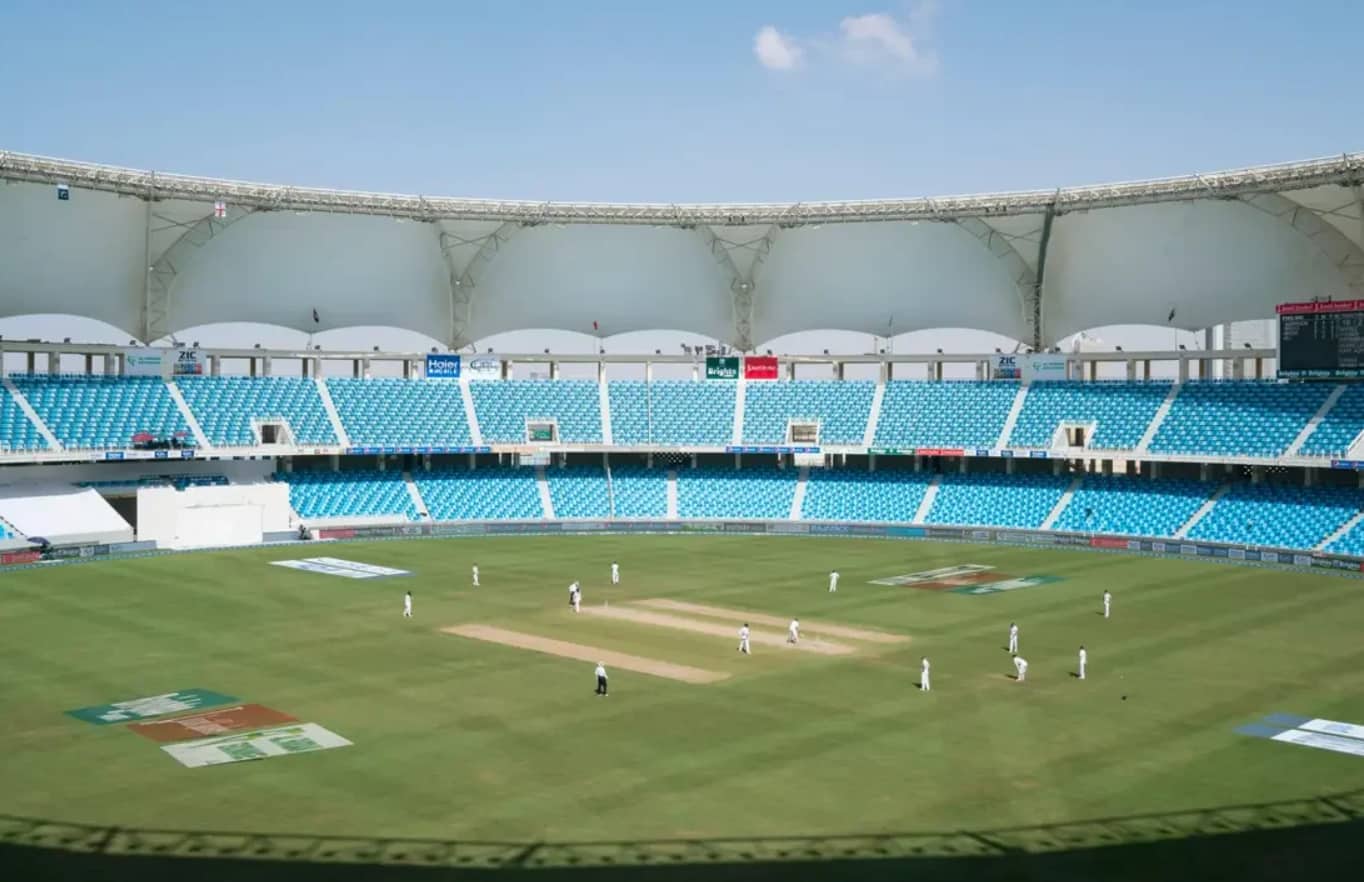
Dubai International Stadium Overview
| Detail | Information |
|---|---|
| Established Year | 2009 |
| Location | Dubai, United Arab Emirates |
| Also Known As | Dubai Sports City Cricket Stadium |
| Ends Name | Emirates Road End, Dubai Sports City End |
| Seating Capacity | 25,000 |
| Shortest Boundary | 59.43 meters |
| Longest Boundary | 64 meters |
| Floodlights | Yes (Ring of Fire system) |
| Pitch Type | Grass |
Dubai International Stadium Pitch Report: Match Phases and Formats
The Dubai International Cricket Stadium Pitch Report shows how conditions shift from seam-friendly opening overs to spin-dominated middle phases, finishing with batting-friendly conditions under lights.
Each phase requires different tactical approaches from both teams.
Early Overs / New Ball
Fast bowlers extract seam movement and occasional swing during the first powerplay, particularly in ODIs and evening T20Is.
The new ball encourages pacers to attack the stumps and test batsmen’s technique early. This initial movement doesn’t typically cause major collapses but creates enough uncertainty to keep scoring rates in check.
The grip available helps bowlers maintain control without offering excessive lateral movement. Batsmen who survive the opening exchanges usually find run-scoring becomes easier as the ball softens.
Early and Later Overs
The surface settles after the powerplay, with the ball starting to grip and turn.
Spinners become increasingly effective during this middle phase, especially when the venue hosts multiple matches in quick succession.
Flight variations and pace changes work better than raw spin on this surface.
Batsmen who rotate strike effectively and place the ball into gaps gain advantages during this phase.
The transition from aggressive powerplay batting to calculated accumulation defines most successful innings here. Smart placement becomes more valuable than power hitting in overs 7-15.
Under the influence of Light / Mist
Night matches bring milder weather conditions with increased humidity affecting the outfield.
Dew makes the ball skid through, reducing grip for spinners and making batting considerably easier. Teams chasing totals benefit significantly from these conditions.
Captains winning the toss in T20Is and day-night ODIs frequently choose to bowl first.
The final overs become comfortable for batsmen as the ball comes onto the bat cleanly without turning or gripping.
Dubai International Cricket Stadium Records And Statistics
T20I Stats and Records
| Stat | Value |
|---|---|
| Total Matches | 120 |
| Matches Won Batting First | 55 |
| Matches Won Bowling First | 63 |
| Average 1st Innings Score | 140 |
| Average 2nd Innings Score | 123 |
| Highest Total Recorded | 212/2 (20 Ov) by IND vs AFG |
| Lowest Total Recorded | 55/10 (14.2 Ov) by WI vs ENG |
| Highest Score Chased | 184/8 (19.2 Ov) by SL vs BAN |
| Lowest Score Defended | 98/5 (20 Ov) by NAMW vs UAEW |
ODI Stats and Records
| Stat | Value |
|---|---|
| Total Matches | 63 |
| Matches Won Batting First | 23 |
| Matches Won Bowling First | 38 |
| Average 1st Innings Score | 220 |
| Average 2nd Innings Score | 195 |
| Highest Total Recorded | 355/5 (50 Ov) by ENG vs PAK |
| Lowest Total Recorded | 91/10 (31.1 Ov) by NAM vs UAE |
| Highest Score Chased | 287/8 (49.4 Ov) by SL vs PAK |
| Lowest Score Defended | 168/10 (46.3 Ov) by UAE vs NEP |
Test Stats and Records
| Stat | Value |
|---|---|
| Total Matches | 13 |
| Matches Won Batting First | 6 |
| Matches Won Bowling First | 4 |
| Average 1st Innings Score | 336 |
| Average 2nd Innings Score | 298 |
| Average 3rd Innings Score | 260 |
| Average 4th Innings Score | 224 |
| Highest Total Recorded | 579/3 (155.3 Ov) by PAK vs WI |
| Lowest Total Recorded | 90/10 (35.3 Ov) by NZ vs PAK |
Dubai International Stadium: A Batting Pitch or A Bowling Pitch
The Dubai International Cricket Stadium Pitch Records show a balanced contest with advantages shifting between bat and ball depending on match phase and format.
The surface evolved considerably after hosting major tournaments, including the T20 World Cup 2021, Pakistan Super League, and multiple Asia Cup editions.
For Batting
- Powerplay scoring opportunities: Batsmen find run-scoring easier once the initial seam movement subsides in T20Is and ODIs. The true bounce and consistent pace help stroke-makers time their shots effectively through the line.
- Night match advantage: Dew during evening games makes the ball skid onto the bat, reducing spin and slower-ball effectiveness. Chasing teams consistently perform better under lights, with second-innings averages reflecting this advantage across formats.
- T20 scoring trends: High totals became standard in T20 cricket here, with teams regularly crossing 170-180. The Dubai International Cricket Stadium Capacity of 25,000, has witnessed several high-scoring encounters, particularly in bilateral series and league matches.
For Bowling
- New-ball assistance: Fast bowlers exploit early seam movement and occasional swing during day matches. The harder new ball, combined with morning conditions, creates the best bowling phase, though it rarely produces complete batting collapses.
- Middle-over spin control: Spinners dominate proceedings once the pitch dries out and the ball starts gripping. Variations in flight and pace work more effectively than turning the ball sharply. The Dubai International Cricket Stadium Matches show spinners taking crucial middle-order wickets regularly.
- Test match deterioration: Test surfaces break down from the third day onwards, giving spinners significant advantages. Fourth-innings averages drop to 224 runs, indicating increasing difficulty for batsmen as matches progress.
Overall Pitch Nature
The Dubai International Cricket Stadium Stats demonstrate a surface that provides balanced conditions across formats.
First-innings scores average 140 in T20Is, 220 in ODIs, and 336 in Tests, showing the pitch allows runs without being overly batting-friendly.
Chasing teams hold clear statistical advantages, winning 63 of 120 T20Is and 38 of 63 ODIs when bowling first.
This trend stems primarily from dew in night matches rather than pitch characteristics alone. Teams batting first must post above-average totals to defend successfully.
Format-wise behavior remains consistent. Limited-overs cricket sees competitive totals with second-innings advantages.
Test matches offer first-innings runs before deteriorating gradually, creating results by days four and five.
FAQs: Questions & Answers
- Q1. When was the Dubai International Cricket Stadium built?
The stadium opened in 2009, hosting its first international match on April 22, 2009, when Australia played Pakistan.
- Q2. Is the pitch in Dubai better for batting or bowling?
The pitch offers balanced conditions with early assistance for seamers, middle-overs spin grip, and batting-friendly conditions under lights. Chasing teams hold statistical advantages in limited-overs formats.
- Q3. What is the average score at the Dubai ground in T20?
The average first-innings score in T20 matches at Dubai International Stadium is 140 runs, while the second-innings averages drop to 123 runs.
- Q4. What is the total capacity of the Dubai Cricket Stadium?
Dubai International Stadium seats 25,000 spectators, with plans to expand capacity to approximately 30,000 in the future.
- Q5. Who designed the Dubai Stadium?
Canadian architect Awsam Matloub led the design of Dubai International Cricket Stadium, including the unique “Ring of Fire” lighting system.
Conclusion:
The Dubai International Cricket Stadium pitch report confirms a versatile surface that tests both batting and bowling skills across match phases.
Key tactical considerations include:
- Early-overs planning – Pacers extract movement with the new ball, requiring a careful batting approach in the powerplay.
- Middle-phase adaptation – Spinners gain control as the pitch grips, demanding smart rotation and placement from batsmen.
- Chasing advantage – Night matches heavily favor teams bowling first due to dew, making toss decisions crucial.
- Format dependency – T20s see high scores with chasing bias, ODIs follow similar patterns, while Tests deteriorate progressively, favoring bowlers.
Teams succeeding here understand these phase-wise changes and adjust their tactics accordingly.
The pitch’s balanced nature ensures competitive cricket without extreme advantages for either discipline.
Also Check:
- Holkar Cricket Stadium Indore Records
- Niranjan Shah Stadium Rajkot Records
- Narendra Modi Stadium Record
- BRSABV Ekana Cricket Stadium Records
- HPCA Stadium Dharamsala Records
- Maharaja Yadavindra Singh International Cricket Stadium Record
- Barabati Stadium Records
- VCA Stadium Jamtha Nagpur Records
- Central Broward Regional Park Stadium Turf Ground Pitch Report
- Shaheed Veer Narayan Singh International Stadium Raipur Records
- Dr. Y.S. Rajasekhara Reddy ACA VDCA Cricket Stadium Records and Pitch Report
- Greenfield International Stadium Records and Pitch Report
About the Author
