Cricket earnings in India follow different tax rules from regular salaries.
Professional players face multiple income streams, each taxed under specific heads with varying rates and deductions.
In India, income earned by professional cricketers is taxed based on residential status and the nature of earnings.
Match fees, endorsements, prize money, and league income are treated under different tax heads, mainly as business or professional income, and taxed at applicable individual rates.
Cricket has evolved from a sport into a multi-crore industry in India.
Players today earn from domestic matches, international tours, franchise leagues, brand deals, and digital platforms.
Understanding cricket player income tax in India is essential for both aspiring and established professionals.
The tax treatment varies significantly based on the income source, residential status, and whether earnings come from Indian or foreign leagues.
Young players entering state teams or IPL often face confusion about TDS deductions, GST requirements, and proper income classification.
How Income Tax Applies to Cricket Players in India?
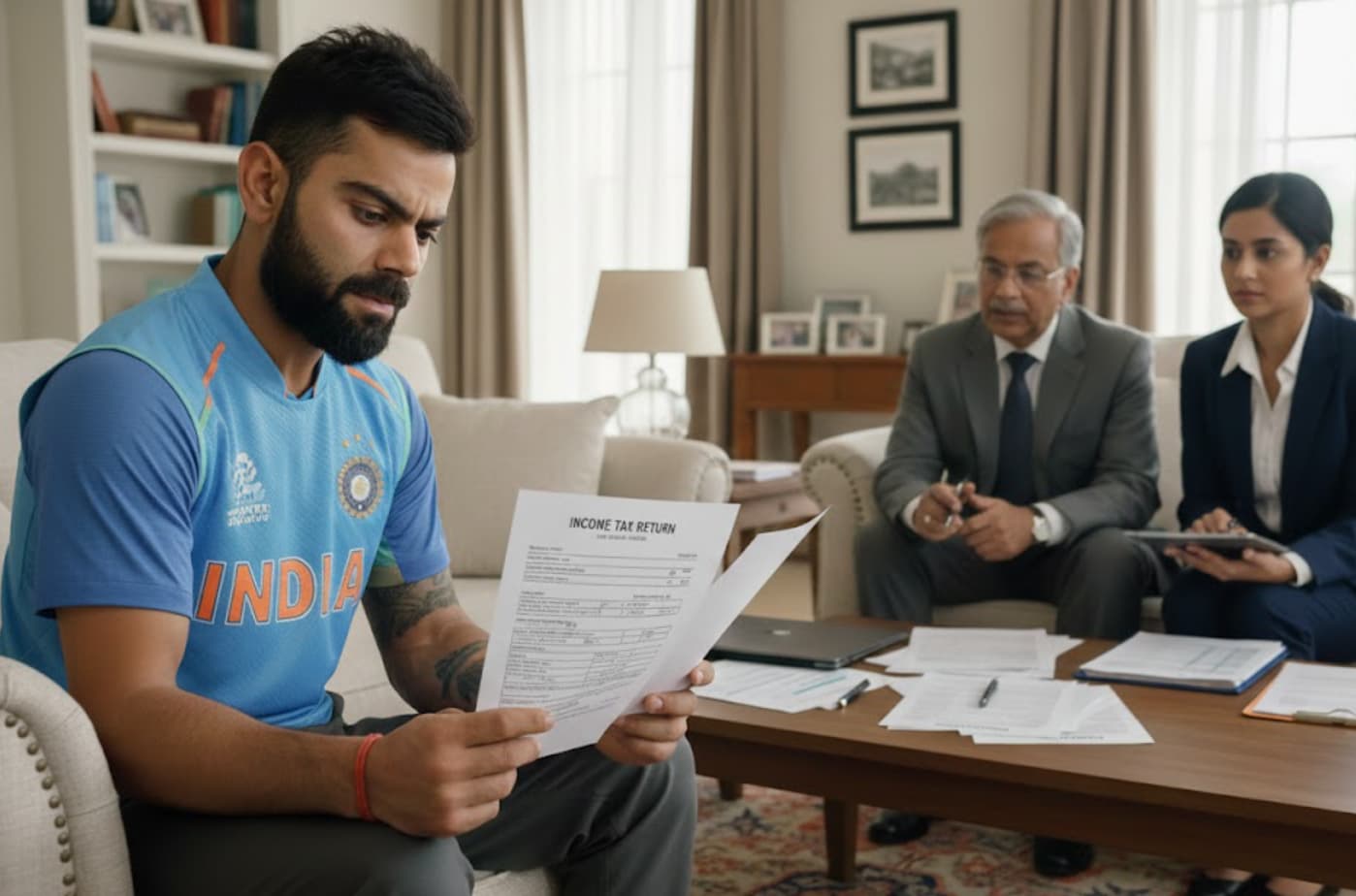
This guide breaks down each income type with clear examples and tax implications.
Why is cricket income taxed differently in India?
Cricket is classified as a professional activity, not salaried employment.
This fundamental distinction changes how every rupee is taxed.
Most cricketers work as independent professionals rather than employees.
They don’t receive monthly salaries with standard deductions.
Instead, earnings fall under “Income from Business/Profession” for most categories.
Unlike salaried employees who get automatic deductions for standard expenses, cricketers must track and claim business expenses.
They can deduct training costs, equipment, travel, and professional fees from taxable income.
The nature of cricket income also triggers GST obligations.
Players providing professional services must register for GST and charge 18% on applicable income streams.
Residential Status and Its Impact on Tax
Tax liability depends heavily on whether a cricketer is classified as a Resident or Non-Resident Indian (NRI).
Resident cricketers pay tax on worldwide income.
This includes:
- Matches played in foreign countries
- Overseas league earnings
- International brand deals
- Prize money from global tournaments
Non-Resident cricketers pay tax only on India-sourced income:
- Domestic matches
- IPL and Indian leagues
- Endorsements for Indian brands
- Income received or earned in India
Residential status is determined by physical presence in India during the financial year.
Players touring extensively overseas may qualify as NRI, significantly reducing their tax burden on foreign earnings.
Match Fees and How They Are Taxed
Match fees form the base income for professional cricketers, paid by BCCI, state associations, or other cricket boards.
The income tax on cricketers in India treats match fees as professional income. Tax applies under “Income from Business/Profession” at slab rates based on total annual income.
Tax mechanics:
- TDS deduction: 10% (under Section 194J)
- GST: 18% on all matches except government-organized games
- Taxed at individual slab rates (5% to 30% based on income bracket)
Example: If a player receives Rs 50 lakh as match fees from BCCI, the board deducts Rs 5 lakh as TDS. The player reports this income in their ITR and pays additional tax based on their total annual income and applicable slab.
State cricket associations follow the same TDS pattern. Players must collect and submit GST separately.
Prize Money and Awards – Tax Treatment
Prize money and awards follow different tax rules from match fees. The distinction matters significantly for final tax liability.
Tournament prizes and performance awards:
- Tax head: Income from Other Sources
- Tax rate: 30% (treated as winnings)
- TDS: 30% deducted at source
Government awards (exempt):
- Arjuna Award
- Rajiv Gandhi Khel Ratna
- Padma awards
- Any government recognition awards
Example: A player winning the Man of the Match prize of Rs 1 lakh faces a 30% TDS deduction immediately. The same 30% rate applies when filing returns, making it one of the highest-taxed cricket income categories.
Performance bonuses from franchises are taxed differently—as business income at slab rates, not as winnings.
Advertisement and Endorsement Income
Brand endorsements generate substantial income for cricket players. Tax on cricket match fees differs significantly from endorsement taxation.
Players earn from multiple advertising channels:
- Television commercials
- Product endorsements
- Social media promotions
- Digital platform partnerships
Tax structure:
- Tax head: Income from Business/Profession
- TDS: 10% (Section 194J)
- GST: 18% applicable
- Final tax: Individual slab rates
Endorsement income isn’t salary, even for long-term brand ambassadorships. Companies deduct 10% TDS and issue Form 16A. Players must charge and remit GST separately.
Social media influencer income follows the same rules. Instagram posts, YouTube collaborations, and sponsored content all qualify as professional income requiring GST registration above threshold limits.
IPL and Private League Earnings
IPL has revolutionized cricket earnings in India. Understanding the tax treatment of ipl income helps players maximize take-home pay.
Franchise payments come in various forms:
- Auction fees
- Retention money
- Signing bonuses
- Match fees
- Performance incentives
All IPL earnings are taxed as business/professional income at individual slab rates.
IPL Income Tax Structure:
| Income Type | Tax Head | TDS Rate | GST |
|---|---|---|---|
| Auction Fee | Business/Profession | 10% | 18% |
| Retention Money | Business/Profession | 10% | 18% |
| Signing Bonus | Business/Profession | 10% | 18% |
| Match Fees | Business/Profession | 10% | 18% |
Franchises deduct 10% TDS on all payments. Players file ITR showing total income and pay balance tax based on their slab.
GST applies to all IPL income. Players must register, collect GST from franchises, and file monthly/quarterly returns.
Overseas League Income and Foreign Tax Credit
Indian cricketers increasingly participate in foreign leagues like the Big Bash League (BBL), the Caribbean Premier League (CPL), and Pakistan Super League (PSL).
Foreign league income is taxed as business/professional income in India for resident cricketers. However, the foreign income tax for indian cricketers can be claimed as a credit.
How the foreign tax credit works:
- Player pays tax in the foreign country (where the league operates)
- India taxes the same income (for residents)
- Foreign tax paid is deducted from the Indian tax liability
Players must maintain proof of foreign taxes paid. The DTAA (Double Taxation Avoidance Agreement) between India and the relevant country determines relief eligibility.
Example: A player earns Rs 2 crore from the BBL in Australia. Australia deducts 30% tax. In India, if the player falls in the 30% slab, they can claim full credit for Australian tax paid, avoiding double taxation.
Without DTAA, foreign taxes may not be fully creditable, leading to a higher overall tax burden.
Gifts Received by Cricketers
Cricketers receive gifts from various sources. Tax treatment depends on who gives the gift and the relationship.
Gifts from fans or public:
- Tax head: Income from Other Sources
- Fully taxable at slab rates
- No specific exemption limit
Gifts from franchises or sponsors:
- Tax head: Income from Business/Profession
- Taxed at applicable slab rates
- Often, TDS is deducted
Gifts in kind (cars, watches, property) are valued at fair market value and taxed accordingly. The giver issues a valuation certificate for expensive items.
Cash gifts above Rs 50,000 in aggregate from non-relatives during a financial year attract full taxation. Players must report all such gifts in their ITR.
Coaching, Commentary, and Media Work
Post-retirement or off-season activities generate significant income for many cricketers. These earnings maintain tax obligations.
Common post-cricket income sources:
- Cricket coaching and academies
- Television commentary
- Match analysis shows
- Sports journalism
- YouTube channels
Tax mechanics:
- Tax head: Income from Business/Profession
- TDS: 10% (Section 194J)
- GST: 18% on services provided
- Final tax: Individual slab rates
Former players running coaching academies must register as businesses, maintain books of accounts, and file GST returns regularly.
Commentary contracts with broadcasters involve TDS deduction. Freelance commentators issue invoices with GST for each assignment.
Payments to Non-Resident Cricketers in India
Foreign players participating in IPL or Indian leagues face specific tax rules. BCCI and franchises must comply with TDS and GST regulations.
Tax obligations for overseas players:
- TDS rate: 20% on all payments (Section 195)
- DTAA relief available if applicable
- Form 15CA/15CB is required for foreign remittance
- GST: 18% under the Reverse Charge Mechanism (RCM) if services are provided in India
Example: An Australian player earns Rs 5 crore from IPL. The franchise deducts 20% TDS (Rs 1 crore). If the India-Australia DTAA provides relief, the player can claim a refund while filing returns.
RCM means that franchises pay GST even if the foreign player doesn’t register in India. This applies when services are consumed in India.
Foreign players must check their home country’s tax laws and DTAA provisions to optimize tax efficiency.
Common Tax Mistakes Cricket Players Should Avoid
Even high-earning cricketers make basic tax errors. Avoiding these protects from penalties and legal issues.
Frequent mistakes:
- Mixing personal expenses with business deductions
- Ignoring GST registration requirements
- Not tracking foreign taxes paid for credit claims
- Filing returns after deadlines
- Not maintaining proper income documentation
- Treating all endorsement income as tax-free
- Failing to report cash gifts above limits
- Not segregating different income heads correctly
Late filing attracts penalties of Rs 5,000 to Rs 10,000 plus interest on unpaid tax. GST non-compliance leads to separate penalties.
Players should maintain separate bank accounts for professional income. Document all expenses claimed as deductions with proper bills and receipts.
Key Takeaways for Indian Cricketers
Understanding cricket player income tax India requires clarity on multiple income streams and their specific tax treatment.
Essential points:
- Most cricket income falls under the Business/Profession head
- Match fees, IPL earnings, and endorsements: 10% TDS, 18% GST
- Prize money is taxed at 30% as winnings
- Residential status determines global vs India-only tax liability
- Foreign league income is eligible for a tax credit
- Government awards are exempt from taxation
- GST registration is mandatory for professional services
- Different rules apply to gifts based on the source
Cricket earnings involve complex tax considerations across domestic and international jurisdictions.
Professional guidance helps optimize legitimate deductions and ensure full compliance.
The GST on cricket players income alone requires monthly attention and proper documentation.
Players should consult chartered accountants specializing in sports taxation.
Early planning, proper record-keeping, and timely filing prevent legal complications while maximizing post-tax earnings.
Also Check:
- Indian Cricket Players Salaries 2026
- ICC Cricket Umpire Salary
- IPL Commentators Salary
- Highest Paid Cricket Coaches in the World 2026
- Most Expensive Player in IPL 2026
About the Author
