It’s the final over of an IPL match. Mumbai needs 12 runs to win. The set batter just got out, and the new player is still in the dressing room, frantically strapping on his pads.
The umpire looks at his watch. Fifteen seconds pass. Thirty seconds. The fielding team starts appealing.
Forty-five seconds. The batter rushes down the pavilion steps, helmet half-secured. Sixty seconds.
He reaches the boundary rope, sprinting toward the crease. Seventy-five seconds. He crosses the rope and makes it to the crease with just 10 seconds to spare.
The crowd erupts in relief. He was almost given out as “timed out” without facing a single ball.
This real-world pressure moment illustrates why understanding batting rules in cricket is so crucial.
These aren’t just technicalities written in dusty rulebooks – they’re living regulations that can decide matches, end careers, or create legendary moments.
Whether you’re stepping onto a cricket field for the first time or you’ve been playing for years, knowing these rules transforms how you approach the game.
Cricket’s batting regulations come from the Marylebone Cricket Club (MCC), which writes the Laws of Cricket.
The International Cricket Council (ICC) then adapts these for international matches. These rules ensure every player competes on fair ground, from village cricket in India to Test matches at Lord’s.
Batting Rules in Cricket
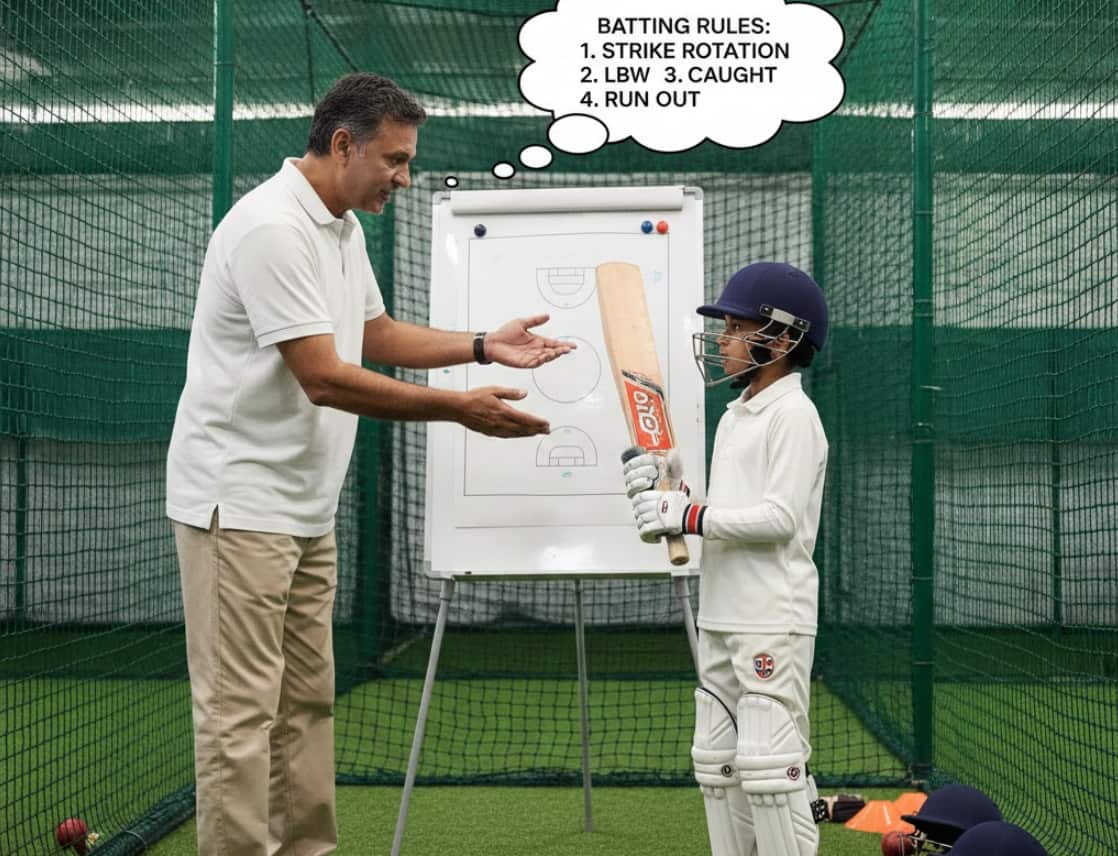
This guide will walk you through everything—from how you stand at the crease to how you score runs legally—in simple, friendly language that feels like a coach sitting beside you.
Understanding the Batter’s Role: What Are You Actually Supposed to Do?
Before we dive into specific rules, let’s understand what cricket expects from a batter. Under the rules of cricket, a batsman has clear responsibilities that vary based on their position and match situation.
Different Types of Batters and Their Roles
| Batter Type | Batting Position | Primary Job | Key Skills | Format Focus |
|---|---|---|---|---|
| Opener | 1-2 | Face new ball, see off early threats, build foundation | Solid technique, patience, concentration | All formats |
| Anchor | 3-4 | Stabilize innings, rotate strike, build partnerships | Temperament, shot selection, adaptability | Tests, ODIs |
| Aggressor | 4-6 | Accelerate scoring, dominate bowling, change momentum | Power hitting, risk management, innovation | ODIs, T20s |
| Finisher | 6-7 | Close out innings, hit boundaries under pressure, farm strike | Composure, power, match awareness | ODIs, T20s primarily |
| All-rounder | 6-8 | Provide depth, support top order, contribute crucial runs | Versatility, quick scoring, basic defense | All formats |
| Tailender | 9-11 | Support partners, block out overs, occasionally attack | Survival skills, simple defense, bravery | Tests mainly |
Each role comes with different expectations under cricket’s laws. An opener must be ready within 3 minutes (or 90 seconds in T20s) after the toss.
A finisher needs to understand powerplay restrictions. A tailender must know how to protect their wicket legally. Understanding your role helps you apply the rules correctly.
Equipment Rules: Your Bat, Gloves, and Gear Must Follow Standards
Let’s talk about your tools. Cricket is very specific about equipment, especially the bat. MCC Law 5 governs bat specifications, and breaking these rules can get you penalized or disqualified.
Bat Specifications (Law 5)
| Bat Part | Maximum Measurement | Why It Matters |
|---|---|---|
| Total Length | 38 inches (96.52 cm) | Ensures fair reach for all players |
| Total Width | 4.25 inches (10.8 cm) | Controls hitting surface size |
| Edge Thickness | 40 millimeters | Prevents “super bats” that give unfair power |
| Spine Depth | 67 millimeters | Maintains bat balance and fairness |
| Handle Length | Maximum 52% of total bat length | Keeps proper bat proportion |
| Handle Shape | Must be round, covered in rubber/cane | Safety and grip standardization |
| Blade Material | Only wood (typically willow) | Traditional material requirement |
Real Story: In 2016, some players used bats with 50mm+ edges. These thick edges meant even mishits flew for boundaries. Bowlers complained it was unfair. In 2017, the MCC changed the rules, capping edges at 40mm. Now, before international series, officials check every bat. If yours doesn’t comply, you can’t use it. This shows how equipment rules protect the game’s balance.
Other Equipment Rules
Gloves:
- Must not extend beyond wrist
- Can have protective webbing between fingers
- Cannot be altered to catch the ball better
Helmet:
- Strongly recommended (mandatory in most professional cricket)
- Must fit properly
- If helmet falls and hits stumps, you’re NOT out (unless ball hits it after hitting you)
Pads:
- Protect legs from fast bowling
- Must not be used deliberately to kick the ball (that’s LBW!)
- No metal parts that could damage the ball
The Stance: Building Your Foundation at the Crease
Your stance is where everything begins. It’s how you position yourself before the bowler releases the ball. Cricket’s laws don’t dictate exactly how you must stand, but they do set boundaries—literally.
Taking Your Guard (Law 36.3)
Before facing your first ball, you’ll ask the umpire for a “guard.” This helps you align with the stumps:
Most Common Guards:
- Leg Stump Guard: Your bat aligns with the leg stump. Good for playing across your body.
- Middle Stump Guard: Bat aligns with the middle stump. Gives you a view of all three stumps.
- Middle-and-Leg Guard: Between middle and leg (most popular). A balanced view allows shots from both sides.
- Two Legs Guard: Outside leg stump. Very defensive, used rarely.
The umpire will stand behind the stumps and guide you: “Move a bit right… stop there.” You mark that spot with your bat. This is 100% legal and encouraged. Players like Steve Smith take multiple guards and adjust constantly—perfectly fine as long as you don’t waste time.
The 5 Batting Techniques in Cricket Every Beginner Must Learn
📋 Five Essential Batting Techniques
1. STRAIGHT DRIVE
- Most elegant and safest shot in cricket
- Play straight back past the bowler
- Keep your head still, weight forward
- High elbow, full bat face
- When to use: Full, straight balls on or outside off stump
2. DEFENSIVE BLOCK
- Your survival technique
- Soft hands, bat angled downward
- Dead-bat the ball into the ground
- Weight on front foot (forward defense) or back foot (backward defense)
- When to use: Good-length balls, when preserving wicket matters most
3. PULL SHOT
- Powerful attacking stroke
- Play to short balls between hip and chest height
- Weight transfers to back foot
- Bat swings horizontally
- When to use: Short-pitched deliveries, when you need quick runs
4. CUT SHOT
- Attacking shot to balls outside off stump
- Played off back foot
- Bat cuts down at angle
- Ball travels through point region
- When to use: Short, wide balls that you can free your arms on
5. SWEEP SHOT
- Specific to spin bowling
- Get down on one knee
- Sweep bat across your body
- Ball goes to leg side
- When to use: Against spinners, particularly in Asian conditions
These five techniques must be played within the crease (the white line). If you step outside and miss, the wicketkeeper can stump you. That’s a key rule we’ll cover shortly.
Entering the Field: You’re on the Clock!
Here’s a rule many casual fans don’t know: when a wicket falls, the next batter has a strict time limit to reach the crease and be ready. This falls under Law 40.1, and it’s different across formats.
Time Limits for New Batters
Test Cricket & ODIs:
- 3 minutes from the moment the wicket falls
- Clock starts when the previous batter is officially dismissed
- You must be at the crease, ready to face the next ball
- If you exceed this, you can be given out “timed out”
T20 Cricket:
- 90 seconds only!
- Much stricter because the format is faster
- Umpires watch this closely in leagues like IPL, BBL, PSL
- Teams must have the next batter padded up and ready
Understanding batting rules in cricket t20 means knowing that this 90-second rule could cost you your wicket before you face a single ball. It’s happened in domestic cricket, though it’s incredibly rare.
Real Match Situation
In the 2023 ODI World Cup, Sri Lanka’s Angelo Mathews became the first player ever dismissed “timed out” in international cricket. His helmet strap broke just as he reached the crease.
He signaled for a replacement helmet, but Bangladesh appealed before the 3 minutes expired.
The umpires had no choice; Mathews was given out without facing a ball. Controversial? Yes. Legal? Absolutely. It showed that equipment readiness matters just as much as batting skill.
Pro Tip: Always have your equipment checked and ready. Keep spare gloves, helmets nearby. In T20 cricket, especially, you should be fully padded up if you’re batting next.
Running Between the Wickets: Understanding Crease Rules
Scoring runs means running between wickets. But there are specific rules about how you do this safely and legally.
The Crease: Your Safe Zone
The popping crease is the white line in front of stumps. To be “safe,” you need:
- Your bat grounded (touching the ground)
- Any part of your bat or body behind the crease
- This must happen BEFORE stumps are broken
Running Rules Breakdown
| Situation | Rule | What Happens |
|---|---|---|
| Normal Run | Both batters cross and ground bat behind opposite crease | Run is scored, batters switch ends |
| Short Run | Batter doesn’t ground bat behind crease while running | Umpire signals “short run,” that run doesn’t count |
| Run Out | Batter is out of crease when stumps are broken | Batter is dismissed, no run scored |
| Overthrow | Ball goes to boundary after fielder throws | Runs already completed + 4 boundary runs counted |
| Obstruction | Batter deliberately blocks fielder’s throw | “Obstructing the field” dismissal |
Example: Imagine you hit the ball to mid-wicket and run. You’re halfway down the pitch. Your partner drops their bat while running. They reach the crease but their bat isn’t grounded. The fielder throws, hits the stumps. Your partner is OUT—run out—because they didn’t ground their bat properly. This is why you see batters sliding their bats in desperately during tight runs.
The Non-Striker’s Responsibility
At the bowler’s end, the non-striker (the batter not facing) has a crucial rule: Don’t leave your crease before the bowler releases the ball. If you do, the bowler can run you out legally. This is called “Mankading” (after Indian bowler Vinoo Mankad), and while controversial, it’s 100% legal under Law 41.16.
Dismissal Rules: All the Ways You Can Get Out While Batting
Cricket has 10 ways a batter can be dismissed, but some are far more common than others. Let’s focus on the ones directly related to batting rules.
Common Dismissals and Format Likelihood
| Dismissal Type | How It Happens | Test Cricket | ODI Cricket | T20 Cricket |
|---|---|---|---|---|
| Bowled | Ball hits stumps directly | Very Common | Very Common | Common |
| Caught | Fielder catches ball before it bounces | Most Common | Most Common | Most Common |
| LBW | Ball would hit stumps but hits pad first | Very Common | Common | Less Common |
| Run Out | Stumps broken while batter is out of crease | Common | Very Common | Extremely Common |
| Stumped | Wicketkeeper breaks stumps when batter is out | Less Common | Common | Common |
| Hit Wicket | Batter accidentally hits their own stumps | Rare | Rare | Rare |
| Obstructing Field | Batter deliberately blocks fielder | Extremely Rare | Extremely Rare | Extremely Rare |
| Hit Ball Twice | Batter hits ball twice intentionally (not to protect wicket) | Extremely Rare | Extremely Rare | Extremely Rare |
| Handled Ball | Batter touches ball with hand | Extremely Rare | Extremely Rare | Extremely Rare |
| Timed Out | Batter doesn’t arrive within time limit | Extremely Rare | Extremely Rare | Extremely Rare |
LBW (Leg Before Wicket) Explained Simply:
This is cricket’s most technical rule. For LBW:
- Ball must pitch in line with stumps (or outside off stump)
- Ball must hit pad in line with stumps
- Ball must be going on to hit stumps (umpire’s judgment)
- Batter must not have hit the ball with bat first
- If impact is outside off stump, batter must not be playing a shot
It sounds complicated, but essentially, if your pad stops a ball that would have hit the stumps, you’re out.
Retired Hurt vs Retired Out: Leaving the Field Legally
Sometimes batters leave the field mid-innings without being dismissed. Law 25.4 covers this.
Retired Hurt
When it applies:
- You’re injured (pulled muscle, hit by ball, cramping)
- You’re ill (vomiting, dizziness, medical emergency)
- Umpire gives permission
What happens:
- Marked as “retired hurt” on scorecard
- Can return later to continue batting
- Doesn’t count as wicket
- Scorecard shows: “Player Name retired hurt – 45 runs”
Match Example: In 2019, during an India-Australia ODI, Indian batsman Shikhar Dhawan retired hurt after being hit on the elbow by a bouncer. He received treatment, and while he couldn’t return that match, the option remained available. This protected him from losing his wicket while ensuring medical care.
Retired Out
When it applies:
- Tactical decision (captain wants different batter)
- Personal reasons unrelated to injury
- Batter chooses to leave voluntarily
What happens:
- Marked as “retired out” on scorecard
- Counts as official dismissal
- Cannot return unless opposition agrees (almost never happens)
- Extremely rare in professional cricket
Key Difference: Injury/illness = retired hurt (can return). Personal choice = retired out (dismissed).
Batting Order & Strategy: Understanding Your Position
Batting position in cricket isn’t random—it’s strategic. Each number (1-11) carries specific expectations.
Standard Batting Order Breakdown
Positions 1-2 (Openers):
- Face new ball when it’s swinging most
- Need solid technique and patience
- Set foundation for innings
- Examples: Rohit Sharma, David Warner
Position 3 (First Drop):
- Come in if early wicket falls OR continue momentum
- Must be versatile—defend or attack as needed
- Often team’s best batter
- Examples: Virat Kohli, Kane Williamson
Positions 4-5 (Middle Order):
- Build big partnerships
- Accelerate when set
- Rescue innings if top order fails
- Examples: Steve Smith, Joe Root
Positions 6-7 (Finishers/All-rounders):
- Close out innings powerfully
- Hit boundaries in death overs
- Often also bowl
- Examples: Hardik Pandya, Ben Stokes
Positions 8-11 (Tail):
- Usually bowlers who bat
- Support partners, contribute some runs
- Block out difficult periods
- Examples: Jasprit Bumrah, Mitchell Starc
Can You Change Batting Order?
Yes! Teams can send any remaining batter next (except those already out). In T20 cricket especially, teams promote “pinch hitters”—big hitters who come up the order to attack. In Tests, teams send “nightwatchmen”—tailenders who bat late in the day to protect specialist batters.
Powerplay Impact: How Field Restrictions Change Batting
In ODI and T20 cricket, “powerplay” overs restrict how many fielders can stand outside the inner circle. This massively affects batting strategy.
Powerplay Rules by Format
ODI Powerplays:
- Overs 1-10: Only 2 fielders allowed outside 30-yard circle
- Overs 11-40: Maximum 4 fielders outside
- Overs 41-50: Maximum 5 fielders outside
T20 Powerplays:
- Overs 1-6: Only 2 fielders allowed outside circle
- Overs 7-20: Maximum 5 fielders outside
What This Means for Batters:
During powerplays, gaps exist everywhere because fielders are bunched inside the circle. Aggressive batters target boundaries knowing there’s less protection.
In batting rules in cricket India, teams like India and Mumbai Indians have mastered powerplay batting, with openers like Rohit Sharma and Virat Kohli exploiting these restrictions brilliantly.
After powerplays, fielders spread out, making boundaries harder. Batters must adapt—rotating strike becomes crucial, picking gaps rather than always going for big shots.
Format-Based Differences: Test, ODI, and T20 Batting Rules
While core batting rules in cricket remain consistent, each format has unique characteristics that affect how batters approach the game.
Comprehensive Format Comparison
| Aspect | Test Cricket | ODI Cricket | T20 Cricket |
|---|---|---|---|
| Overs per Innings | Unlimited | 50 overs maximum | 20 overs maximum |
| Entry Time | 3 minutes | 3 minutes | 90 seconds |
| Field Restrictions | None | Powerplay overs 1-10 | Powerplay overs 1-6 |
| Batting Approach | Patient, build innings | Balanced, accelerate middle overs | Aggressive from ball one |
| Average Strike Rate | 45-60 | 75-95 | 130-160 |
| Dot Ball Pressure | Minimal (patience rewarded) | Moderate (builds pressure) | Extreme (every dot matters) |
| Follow-On Rule | Yes (200-run lead) | No | No |
| Declaration Possible | Yes | No | No |
| DRS Reviews | 2-3 per innings | 1-2 per innings | 1 per innings |
| Typical Innings Score | 300-400 (day 1-2) | 250-300 | 160-180 |
Full Breakdown: 15 Rules of Cricket That Affect Batting
Here’s a simplified breakdown of the 15 rules of cricket that have the biggest impact on batting:
- Law 5 (The Bat): Your bat must meet size specifications—38 inches max length, 4.25 inches max width, 40mm max edge.
- Law 6 (The Ball): Ball condition affects batting—new ball swings, old ball reverses, worn ball spins more.
- Law 14 (Follow-On): In Tests, if you trail by 200+ runs, opposition can make you bat again immediately.
- Law 15 (Declaration): Captain can close your team’s innings anytime in Tests to set up a result.
- Law 25 (Retired Batter): You can leave the field if injured (retired hurt) and return later.
- Law 28 (Fielder Returning): Affects when substitute fielders can bat if they left the field earlier.
- Law 29 (Wicketkeeper): Defines where the keeper can stand, affecting stumping danger.
- Law 30 (Batter Out of Ground): You must ground bat or body behind crease to be safe from stumping/run out.
- Law 34 (Hit Ball Twice): You can only hit ball twice if protecting your wicket, otherwise it’s out.
- Law 36 (LBW): If ball hits your pad and would’ve hit stumps, you’re out (most technical rule).
- Law 37 (Obstructing Field): Deliberately blocking fielders from catching or throwing gets you out.
- Law 38 (Run Out): If stumps are broken while you’re out of crease, you’re dismissed.
- Law 39 (Stumped): Wicketkeeper breaks stumps when you’re out of crease facing a delivery.
- Law 40.1 (Timed Out): New batter must arrive within 3 minutes (Tests/ODIs) or 90 seconds (T20s).
- Law 41.16 (Mankading): Non-striker leaving crease before ball release can be run out by bowler.
Batting Rules in Cricket PDF: What You’d Find in an Official Guide
Many players and coaches search for batting rules in cricket pdf to have offline reference material. An official PDF from MCC or ICC would include:
Contents of Official Batting Rules PDF:
- Complete Laws 1-42 with batting-specific sections highlighted
- Diagrams showing bat specifications with measurements
- Crease diagrams showing safe zones and danger zones
- Flowcharts for LBW decisions
- Tables comparing format-specific rules (Test/ODI/T20)
- Recent amendments (2017 bat rules, 2022 Mankading clarification)
- Umpire signal references
- Case studies of rare dismissals
Where to Download:
- MCC Official Website: lords.org/mcc/the-laws-of-cricket
- ICC Official Site: icc-cricket.com/about/cricket/rules-and-regulations
- National boards like BCCI, ECB, Cricket Australia also provide PDFs
Having these PDFs helps players reference rules quickly during training, disputes, or match preparation.
Expert Tips for Beginners: Coaching Corner
Let me share some practical batting tips that help you apply these rules effectively:
1. Footwork Fundamentals
- Move your feet to the pitch of the ball
- Front foot for fuller deliveries, back foot for shorter ones
- Stay balanced—weight on balls of feet
- Practice shadow batting to develop muscle memory
2. Eye Level and Head Position
- Keep your head still during shot execution
- Eyes level with the ball at point of contact
- Don’t follow the ball with your head before it’s delivered
- This helps timing and balance
3. Grip and Bat Control
- Hold bat with relaxed grip (not too tight)
- Top hand (left hand for right-handers) guides direction
- Bottom hand provides power
- Adjust grip based on shot type
4. Shot Selection Wisdom
- Play balls on their merit
- Don’t force shots to balls that don’t deserve it
- Leave balls outside off stump in Tests
- In T20s, be more aggressive but still selective
5. Crease Awareness
- Always know where your crease is
- Ground your bat properly when running
- Don’t wander out of crease unless playing a shot
- Watch the wicketkeeper’s position
6. Understanding Match Situations
- In Tests: Focus on building innings, patience wins
- In ODIs: Balance between attack and consolidation
- In T20s: Aggressive intent from ball one, but smart aggression
Batting Rules in Cricket India: Domestic Variations
While international rules apply worldwide, batting rules in cricket India have some interesting domestic tournament variations worth knowing:
BCCI Domestic Tournaments:
- Ranji Trophy (First-Class): Follows Test match rules exactly
- Vijay Hazare Trophy (List A): Follows ODI rules with minor variations
- Syed Mushtaq Ali Trophy (T20): Follows T20I rules
Unique Indian Conditions:
- Spin-friendly pitches mean different shot selection
- DRS not always available in domestic matches (umpire’s decision final)
- Local umpiring sometimes slightly more lenient on time rules
- Heat and humidity affect stamina, leading to more retired hurt instances
IPL-Specific Batting Rules:
- Strategic timeouts don’t affect batter entry timing
- Impact Player rule allows tactical batting substitutions
- Foreign player restrictions affect batting order flexibility
- Stricter enforcement of over-rate penalties affects time between dismissals
Understanding these variations helps if you’re playing in India or watching Indian domestic cricket. The core laws remain the same, but local interpretations and conditions create subtle differences.
Frequently Asked Questions About Batting Rules
- Q1: How long does a new batter have to reach the crease in T20 cricket?
Just 90 seconds in T20 cricket, compared to 3 minutes in Tests and ODIs. This faster rule matches T20’s overall pace. If you exceed this, you can be given out “timed out” without facing a ball.
- Q2: Can I use any size cricket bat I want?
No. Your bat must follow MCC Law 5: maximum 38 inches long, 4.25 inches wide, with edges no thicker than 40mm and spine no deeper than 67mm. Violating this in professional cricket can lead to penalties or disqualification.
- Q3: What’s the difference between retired hurt and retired out?
Retired hurt is for injury/illness—you can return later and it doesn’t count as dismissal. Retired out is a voluntary departure for non-medical reasons—it counts as dismissal and you typically cannot return.
- Q4: Is Mankading really legal now?
Yes, absolutely. In 2022, MCC moved it from “Unfair Play” to the “Run Out” section of laws, confirming it’s completely legitimate. The non-striker must stay behind the crease until ball release.
- Q5: Can I change my guard during an innings?
Yes! You can adjust your guard between deliveries. Players like Steve Smith and AB de Villiers constantly adjusted their guards based on bowling type. Just don’t waste time doing it.
- Q6: What happens if my helmet falls and hits the stumps?
If your helmet falls and hits the stumps, you’re NOT automatically out—UNLESS the ball caused it. If you play a shot and your helmet falls independently and hits stumps, you’re safe. But if the ball hits you, then your helmet falls and hits stumps, that’s “hit wicket” and you’re out.
- Q7: Can batting order change mid-innings in any format?
Yes, in all formats. Teams can send any remaining batter next (except those already dismissed). This is common in T20s with pinch-hitters and in Tests with nightwatchmen.
- Q8: How do powerplay rules affect what shots I can play?
Powerplays don’t restrict your shots—they restrict fielding positions. But knowing only 2 fielders are outside the circle (ODI overs 1-10, T20 overs 1-6) means you can target boundaries more safely since there’s less protection.
Conclusion: Your Journey from Rules to Runs
Understanding batting rules in cricket isn’t about memorizing dry regulations—it’s about unlocking your potential as a player.
Every rule exists for a reason: bat dimensions ensure fairness, time limits maintain pace, crease rules define safety, and dismissal rules create exciting contests between bat and ball.
When you step onto that field—whether it’s a neighborhood game, school tournament, or professional match—you’re part of a tradition centuries old.
The rules aren’t obstacles; they’re the framework that makes cricket beautiful. They ensure a village cricketer in Dharwad follows the same laws as Virat Kohli at Lord’s.
Start simple. Master your stance. Understand your guard. Practice the five fundamental techniques. Learn when you’re safe in your crease and when you’re vulnerable.
Study how rules change between formats. Watch professional cricket with new eyes, noticing how players navigate these regulations while expressing their creativity.
Cricket rewards those who understand its nuances. The batter who knows they have 90 seconds in T20 stays ready. The opener who understands powerplay restrictions targets gaps aggressively.
The tailender who knows how to protect themselves without losing their wicket unnecessarily.
So take these rules, practice them, apply them, and make them second nature.
Soon you won’t think “What does Law 36.3 say about my stance?” – you’ll just take your guard naturally, play your shots confidently, and run between wickets smartly.
The rules will become invisible, and all that will remain is the pure joy of batting: bat in hand, ball coming toward you, and endless possibilities ahead.
Now go out there and play. The pitch is waiting, the bowler’s ready, and you know the rules. It’s time to score some runs.
About the Author
